
How did you find out about the Murray flute?
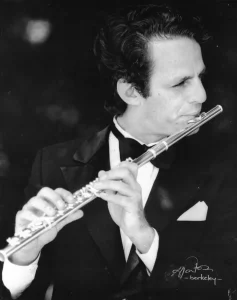
I studied at U of I with Alex and played with many great players who played it. Alex never pushed it or really said much about it unless you asked him.
Please tell us about your flute(s) – when it was made and by whom (or if unknown, where you found it)
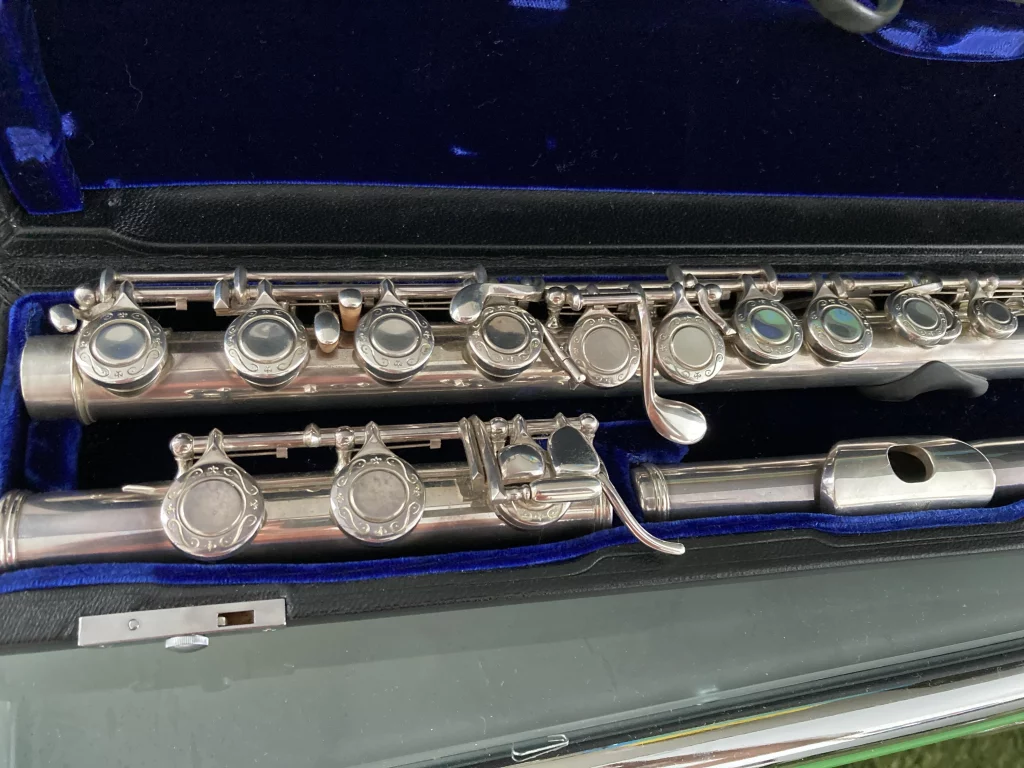
My first Murray flute was Jack Moore #33, formerly owned and played by Alex. This was the flute Nancy Toff left off with in her first edition of Development of the Modern flute. Alex arranged for me to sell my Muramatsu for $1,200 and then sold the Jack Moore flute to me for the same amount. Many years later, he asked to buy it back for the same amount for a professional player who needed a backup flute. By then, I had my Lasewski scale Murray flute and it seemed only fair to pay it forward. Tom Green made my Lasewski scale flute for me in 1998 in exchange for his logo, website and brochure. I had the keys engraved because I didn’t want anyone to think it was a student instrument in the event of my untimely demise. It’s just an incredible instrument, so resonant with so little effort. I didn’t realize until I started this website how few of these were made. I am doing all I can to ensure that someone will make them moving forward.
When did you switch to Murray flute and why?
I have never had an easy time with my fingers. The short answer is, I switched when I had taken my technique to its pinnacle on the traditional flute and wanted to see if I could go further and play with more ease. I could see the logic of the Murray system but resisted changing for many years because I thought there were so many great players who had overcome the traditional flute’s problems, and because change is scary. But Alex was so supportive and it was so much easier than I thought it would be in the end.
How long did it take you to switch?
About 6 weeks. All the while, I was playing a standard piccolo. I had learned the first movement of the Nielsen Concerto from memory on the standard flute and turned around and learned it again on Murray system. I have documented the transition exercises in my Murray Companion booklet and in open g# conversion exercises on this site. I also wrote my Master’s Thesis on my experience changing to Murray System. I will make it available on the site soon.
Do you play other fingering systems or other instruments in addition to your Murray instruments?
Yes. I have 3 piccolos, each with a different configuration: 1- an 1890 Millereau low c piccolo in silver with open g#, Briccialdi thumb and closed d#; 2-A Bulgheroni wood piccolo with open g#, reverse (Boehm) thumb and closed d# (they wouldn’t make open d# for me); 3-A standard silver Haynes built in 1964 with closed g#, Briccialdi thumb and closed d#.
If I play regularly it’s not too hard to go back and forth. The open-closed d# is easy, the open-closed g# trickier.
Did you ever study with Alex Murray, and if so, how would you describe your experience?
I left U of I a completely different player. Like 360-degree different. I used to play with a lot of tension and excess movement, and a buzzy sound, having grown up in the Galway era. Alex taught me so much about resonance, how to use myself to foster ease and a secure technique and above all, musicianship. I’m eternally grateful.
We also had some laughs…I remember his office window looked out on the rooftop of a sorority. One of the women was sunbathing there and Alex was experimenting with a speaker hookup (he was always experimenting and expanding his knowledge… from ragas to shakahachi flute to acoustic principles to who knows what). He put the speaker partly in the open window and began improvising in this very lugubrious, sensual way, with the echo effect on. The woman was like, Is this directed at me? Where is this coming from? She was freaked out. Every time she turned around to look for the perpetrator, he ducked away from the window. We almost wet our collective pants laughing.
Did the murray flute change the way you play in any way?
Very much so. It gave me the freedom to express myself without worrying about how to compensate for a muffled high E, a lousy c#, crappy trills, etc. Moreover, balancing the flute is a lot different than gripping it. You have to be very aware of how you’re using yourself – which is a good thing.
What is your profession?
I am a graphic designer, writer and creative director (and creator of this site). Since 1998, I have owned my own business helping companies large and small put their best foot forward.