How did you find out about the Murray flute?
I had read Boehm’s book and already switched to Open G# – so when I saw “The Sound of a New Instrument” – The Murray Flute LP record Alex did with Martha Goldstein … I read that Armstrong made some prototypes and had them send #7 to a local music store in 1976, which is when I switched to the Murray System.
Please tell us about your flute(s) – when it was made and by whom (or if unknown, where you found it)
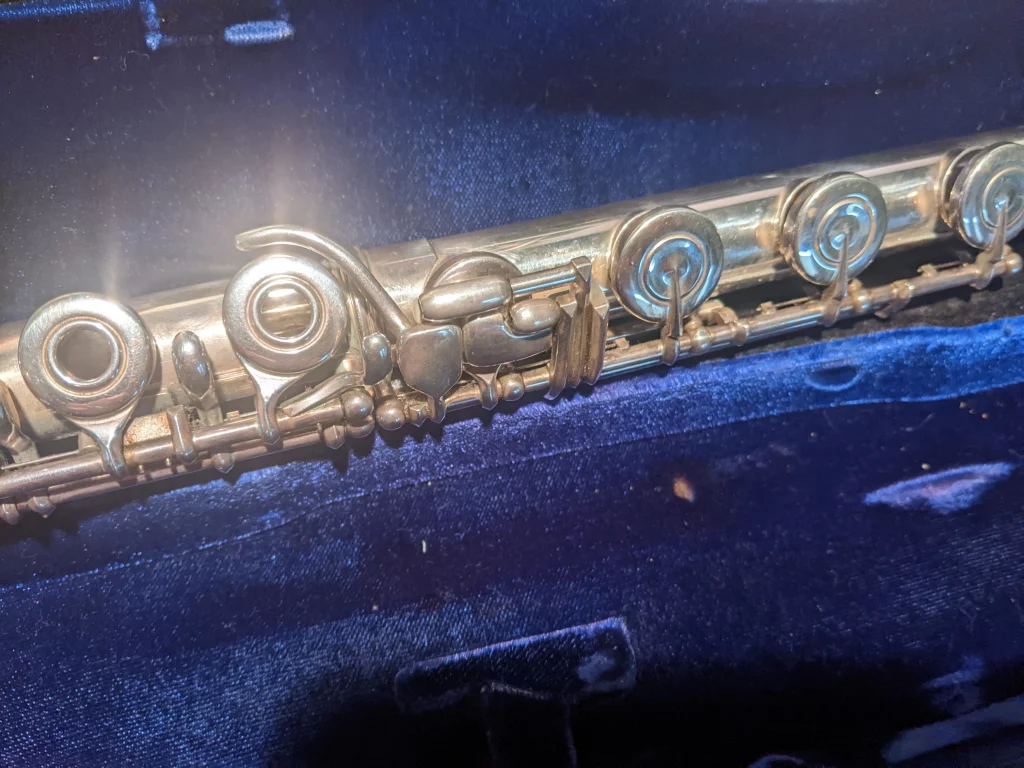
The next one is Jack Moore #40, made in 1978, that I still have. Then around 1986 I had two made by Tom Green and still have #38. In the 2000s, a friend found a David Wimberly Murray flute (#43) at an estate sale which I bought after it was described to me and my friend knew I would be interested.
When did you switch to Murray flute and why?
I never looked back after 1976 when I also went to London to meet Jack Moore and Alex Murray.
How long did it take you to switch?
The switching adjustment period was very quick given that I was already familiar with the open G# and Alex explained most of the right hand to me in person at his place in London.
Do you play other fingering systems or other instruments in addition to your Murray instruments?
I still play standard Bass and Alto flute – no problem going back and forth. Alex and I both agreed one can utilize the advantages of Murray without forgetting the standard system. One does not forget English after one learns Spanish or French.
In addition, when I took up saxophone I had one modified to have open pinky keys but left that procedure to one saxophone as I later took up all sizes and didn’t want to render otherwise valuable instruments modified.
As I said, along with regular flutes, I also play clarinet and six different saxophones with no problems also playing Murray System concert flutes.
Did you ever study with Alex Murray, and if so, how would you describe your experience?
I only had one lesson with Alex Murray but he was very informative – intelligent and charming. That was in London but there was another attempt to study with him in Illinois in 1978 that was unsuccessful. Even so, he was always talkative and helpful with the many conversations we had on the telephone – everything from the latest improvements to who was now making them and where they were. Alex is one of the smartest people I’ve ever met and also very nimble with his physical movements. We did discuss the Alexander Method which is his other great passion. He would say that I was also quite smart and was fully capable of figuring things out myself as well.
Did the murray flute change the way you play in any way?
The Murray flute changed the way I play in that I always felt better having my fingers move more in the direction of the pitch. I made it part of my life to be an exponent of his system. I later spent more time performing improvisational jazz with serious jazz musicians and felt that my expression was more direct and easier. The finger motion just made more sense and the C# in particular is a fuller, more in tune note for the 2nd and 3rd octaves.
What is your profession?
My profession was twofold for decades in that I had a job repairing mechanical items like bicycles and wheelchairs. Later I was able to make some decent progress as a semi-pro musician and played the Murray flute in the Prometheus Orchestra for two seasons as well as ten annual classical recitals. Then the recording and nightclubs beckoned along with some touring and Radio airplay. I particularly enjoyed sending the CDs I made to Alex Murray and Tom Green so that the designer and maker of the instruments could hear the Murray flute as it sounded in another context.