
May 13, 1929 – March 24, 2026
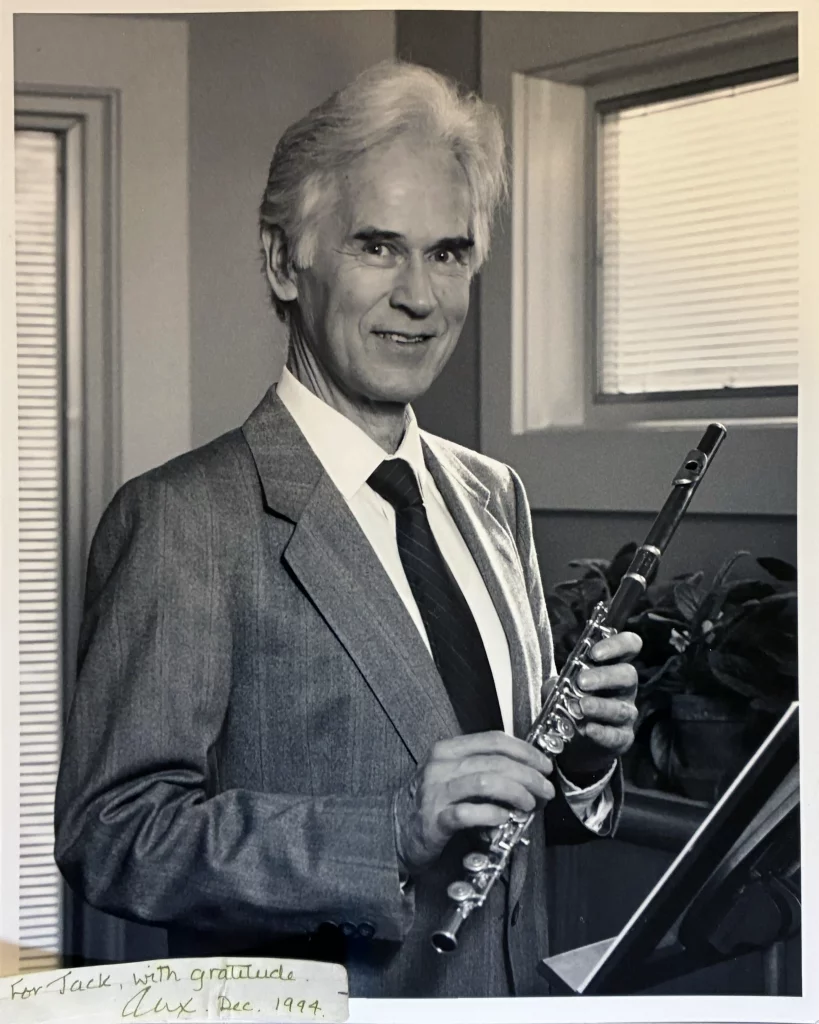
It is with great sadness that we note the passing of Alex Murray, who died after a brief illness on March 24, 2026. He was 96. Pat Zuber and her husband, Greg, had visited Alex and Joan in England just a few months ago.
He is survived by his wife, Joan, and daughter, Fiona. I’m opening this post up to comments for people to share their remembrances. If you also play Murray flute, please reach out so we can add you to the Murray flute player community.
Alex’s memorial service was held Monday, May 18, in London. Fiona shared the link above for the service.
The University of Illinois Music School Director, Linda R. Moorhouse, wrote an excellent obituary. Here, too, is the In Memoriam email sent by the American Society for the Alexander Technique which I believe was drawn from the obituary Fiona Murray penned:
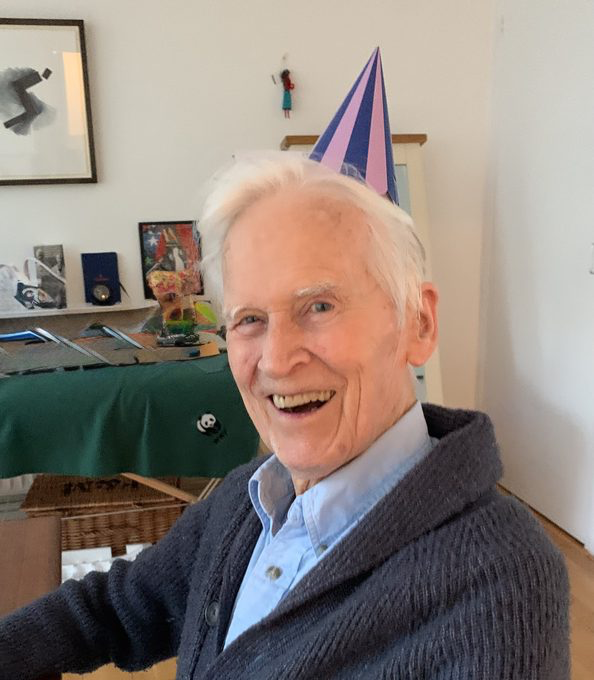
“Alexander “Alex” Douglass Murray, an internationally respected flutist, teacher, and pioneer of the Alexander Technique, passed away on March 24, 2026, at the age of 96.
Born in South Shields, Tyne and Wear, England, Alex was a graduate of the Royal College of Music in London and the Paris Conservatoire, where he was awarded the Premier Prix in performance.
Alex began his remarkable career at just twelve years old, appearing as a soloist with the Cape Town Orchestra, having relocated to South Africa after being evacuated from Britain in 1940 amid the threat of Nazi invasion. Following service in the Royal Air Force Band from 1947 to 1949, he went on to become Principal Flutist with both the London Symphony Orchestra and the Royal Opera Orchestra.
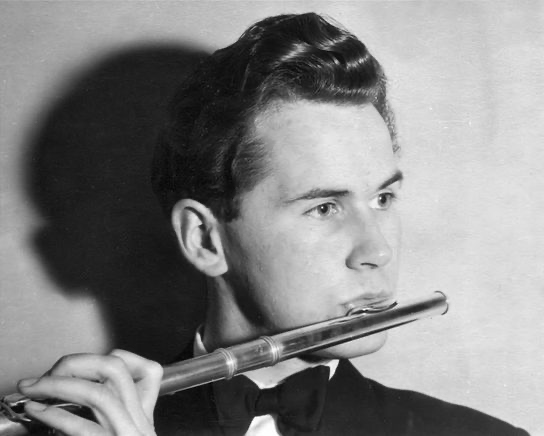
Over the course of his distinguished performing career, he also played principal positions with many leading ensembles, including the Academy of St Martin in the Fields, the English Chamber Orchestra, the Philomusica of London, the Mozart Players, the Bath Festival Orchestra, the BBC Symphony Orchestra, the Royal Philharmonic Orchestra, and the London Philharmonic Orchestra. He was also a founding member of Sinfonia da Camera and the National Flute Association.
Alex’s dedication to teaching matched his accomplishments as a performer. He held positions at Michigan State University, the Royal Dutch Conservatory, the Royal Northern College of Music, the Guildhall School of Music, and the National Music Camp at Interlochen, Michigan. From 1977 to 2002, he served as Professor of Flute at the University of Illinois at Urbana-Champaign. Alongside this appointment, he and his wife, Joan Murray, trained teachers of the Alexander Technique.
Alex’s study of the Alexander Technique began in 1955 with Charles Neil, one of F.M. Alexander’s early trainees. After Neil’s death in 1958, Walter Carrington became a central mentor to both Alex and Joan. They trained as teachers with Walter Carrington in the 1960s and continued working closely with them until relocating to the United States. Through a collaboration with anthropologist Raymond Dart, they developed the Dart Procedures, an evolving exploration of human developmental movement that has had a lasting influence on Alexander Technique teaching worldwide.
During this same period, Alex began developing what became known as the “Murray flute.” Over the course of 44 years, culminating in its final model in 2004, the instrument evolved, stemming from his desire to create a flute that was better in tune, more natural to play, and mechanically reliable while maintaining simplicity of design.
A charter member of AmSAT (formerly NASTAT), Alex, together with Joan, founded and directed a teacher training program in Urbana-Champaign (the Urbana Center for the Alexander Technique) where they trained hundreds of teachers over more than four decades. He was also a prolific author and editor, with works including F.M. Alexander in His Own Words, Alexander’s Way, and (with co-authors) Beginning from the Beginning. He edited Awareness, Poise and Mobility: An Anthology of the Writings of Raymond Dart and delivered the 1982 F.M. Alexander Memorial Lecture in London, titled “John Dewey and F. M. Alexander: 36 years of friendship.”
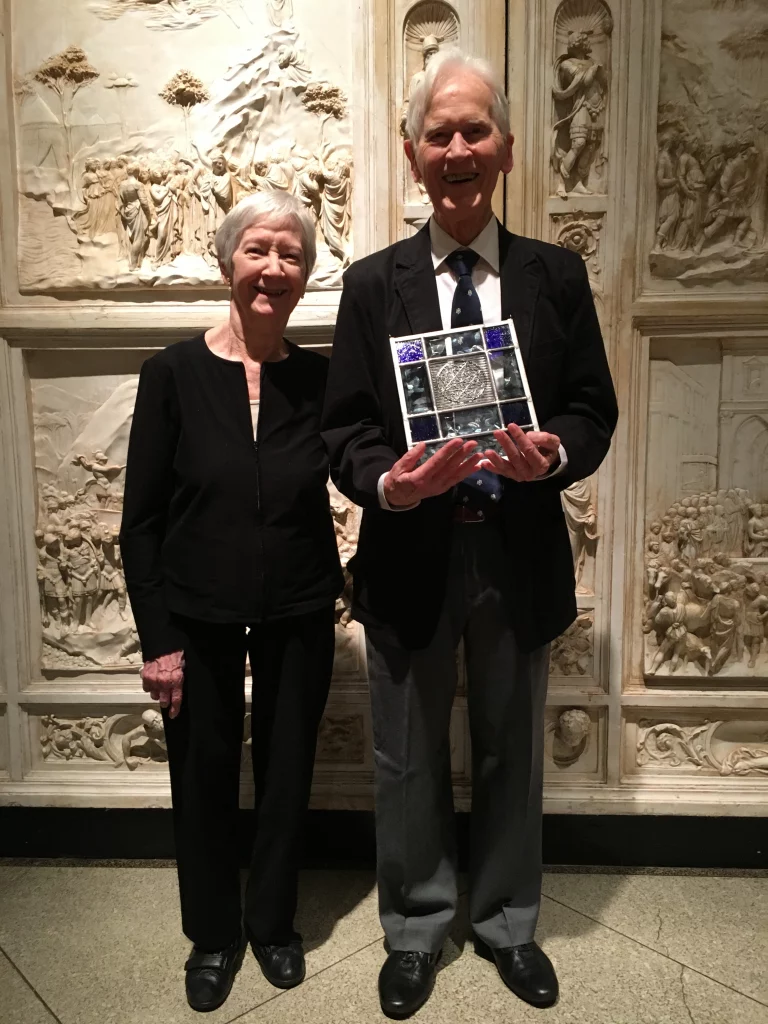
Alex is survived by his wife, Joan, and his daughter, Fiona. His over seven-decade career as a performer, teacher, innovator, and mentor leaves a profound and enduring legacy. He will be remembered not only for his extraordinary accomplishments, but for his boundless enthusiasm, intellectual curiosity, and unwavering pursuit of excellence. His influence lives on in the many students he taught and trained, in the ideas he advanced, and in the example he set throughout his life.
Obituary and photos shared with the permission of Fiona Murray.”
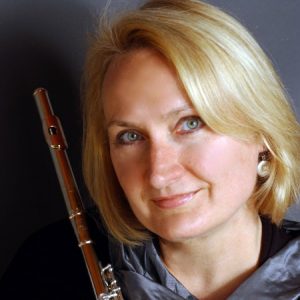
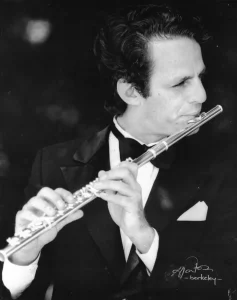
Alex was my most influential teacher and a wonderful musician. His memory lives on in his flutes and all the students who studied with him.
While it was not unexpected, the news of Alex’s passing was very sad. I was one of Alex’s students in the early 70s at MSU. Of all my teachers, he was the best and most influential and definitely the most fun! Growing up in England, I appreciated his great sense of humor. He used to dance around the room at my lessons to make a point or sing silly lyrics to difficult rhythmic passages that I have used with my own students. I wrote a flute method book dedicated to Alex. He was in the process of developing the Murray System Flute and I have three of them and only play on my Murray Flutes.
As well as music I took Alexander Technique classes with Joan and Alex, I babysat for Fiona, and felt a part of the family.
My heart goes out to Joan and Fiona, he will be missed. But, as they say in England,
“He had good innings” 96!
funny you mention the singing and dancing…who doesn’t remember “this Bird IS DEAD!” to the Mozart G major Rondo opening line!
Oh I love that! My silly words were to the 2nd theme of the Prokofiev Sonata, the dotted rhythms, “If you want to know the time, ask a policeman!”
Alex’s passing fills me with deep sadness. Learning from him was more than just about music, the flute or the Alexander Technique but a transfer of life wisdom. He was a wonderful mentor and dear friend.
From my very first lesson with Alex (Interlochen, summer of 1976), he was a uniquely inspiring teacher. Encountering each lesson afresh without an agenda, he would encourage a pupil to open an inquiry into whatever it was she or he would like to learn or improve. There was never any one right way. In fact, he once said to me, “If there is only one right way, then it’s wrong”. From that first fleeting half-hour of exploring articulations through many more lessons, he taught me to look for my own way, based on principles he taught, of mechanical advantage, means-whereby, breath awareness, and musical intentions.
He was a scholar. Although deeply intellectual, his analysis of music was always directed toward creating freedom within the bounds of a composer’s intentions, allowing a fresh interpretation in the moment of performance. His intellectual pursuits were wide-ranging from the famous collaborations with Raymond Dart and with Chungliang Al Huang to his profound readings of the complete works of John Dewey, Charles Darwin and Jiddu Krishnamurti, to name just a few examples. Whatever caught his devotion was pursued with an enthusiasm that was more than inspiring; one could not help but to scurry after the crumbs of wisdom he would toss out and to try to emulate his lively intellect.
Even in advanced age, he was learning and experimenting. His morning practice routine began each day with divisions on grounds, collected in Jacob van Eyck’s Der Fluyten Lust-hof, playing a Renaissance flute holding the instrument mirror-reversed (to the left), followed by Bach played on traverso but transposing the cello suites each day into a different key (“keeps the grey cells working”) and then on to his streamlined two-piece lightweight Murray flute and a daily changing exploration of his favorite pieces. At the age of 86, the opening solo of L’Après Midi was still possible in one breath, his phrasing and control stretching through the long passage seemingly effortlessly.
Thinking of Alex, I remember his lightness, his humor, his courage to change course (within a lesson, within a career). What he knew could sometimes best be expressed through dancing. His words sometimes seemed esoteric but each of his pupils “got it” and will never forget. He didn’t leave us with a method book. His textbook was the living moment. This is what I will never forget and always remember with profound gratitude.
Alex Murray was a hero to me for 50 years. We only met for one lesson in London -1976 but we had many conversations on the telephone thereafter. He was so enthused to meet an American teenager who had picked up a prototype Murray Flute that he tried to give me a white gold model made by Albert Cooper. My living situation was so bad I was not prepared to take it but I will always remember his gesture of incredible generosity. Alex was a rare person who acted on his curiosity and I still have three of his flute designs with some very fond memories of him and his family in London and Illinois, Just thinking about him and the way he alighted onto a ferryboat on the Thames river with the nimble light steps of a fantastic flutist who was married to a ballet dancer. Remarkable person -even though he was perhaps a bit speechless about the realm of music I fell into -Jazz Improv etc……we flutists who met and knew him owe his memory nothing but Love and the Best.
I first met Alex Murray when I studied with him at the National Music Camp, Interlochen, Michigan, the summer before my junior year of high school. I was already a serious flutist, a member of the Chicago Youth Orchestra, but as you can see from the photo (1979), I definitely could benefit from some Alexander Technique!
I had no idea how much Alex would teach me about the flute and life.
Alex taught me how to hold my flute while playing and, through the Alexander Technique, how to hold my body while living. He introduced me to the Taffanel/Gaubert scales. We would start lessons playing through T/G #4 in perpetual motion, with Alex interjecting the appropriate scale while I breathed, always allowing me half the time I had played to breathe. If I played 4 counts, I’d breathe for 2 counts while he played.
Mostly, we played music and he taught me how to phrase. He’d press on my shoulder when there was tension, like a leading tone, and release it upon resolution, so I could literally feel it. He’d actually dance a jig for triple meter. He didn’t seem to want to listen to etudes!
In May of my senior year of high school, I was all set to attend Northwestern University as a biology pre-med major; I had even paid my housing deposit. I had an all-night talk with my older sister and decided at the last minute to pursue music instead of medicine. I couldn’t switch majors at NU, but I had applied to the University of Illinois as a biology major. I phoned Alex from my home in Chicago and explained my situation. He said, “Come on down!”
At U of I, Alex never suggested to me that I should switch to the Murray System flute. I was curious about it, of course, but switching was entirely my idea. I switched during the summer at the National Music Camp after my freshman year.
One day at U of I, I walked into his studio for my lesson, put my music on the stand, and burst into tears. He asked me what was wrong, and I replied that I wanted to change my major. He asked me what had brought this about. Amazingly, I replied that I wanted to switch my major to anthropology! I was taking a course that blew my mind, and I thought that anthropology was my true calling. He didn’t skip a beat. He walked over to his music cabinet and pulled out some papers. He asked me if I had heard of the Taung Child. I said, “Of course!” We had learned about it in class, as it was hailed as a missing link. Alex told me that Raymond Dart discovered it, and he had also written the article that Alex handed me. The title of the article was The Human Monthly Cycle and Its Relation to Work, published in 1935. He said he was a friend of Raymond Dart, and Dart had entrusted Alex with organizing his papers after his death! Alex said you could have more interests than just playing the flute! (When I later read the article, I realized it was an early observation of biorhythms and that I was having my menstrual cycle the day of my lesson!)
Alex and I stayed in touch through the years, mostly through Christmas greetings, but still, he would surprise me. We were corresponding, and I mentioned Joseph Campbell and his famous interviews with Bill Moyers. He amazed me by telling me Campbell was also a friend of his!
When Alex received his Lifetime Achievement Award from the National Flute Association in 2015, I was put in charge of organizing the recital of his students and colleagues who honored him. What a roster of luminaries Alex touched.
I feel so thankful that I was able to visit Alex and his spectacular wife Joan at their home in London in November of 2025. He had the same twinkle in his eye at 97 years old as the man I had met 48 years before!
Hardly a day goes by that I do not think of him and wish he were still around, because I have a few more questions for him!