
preface
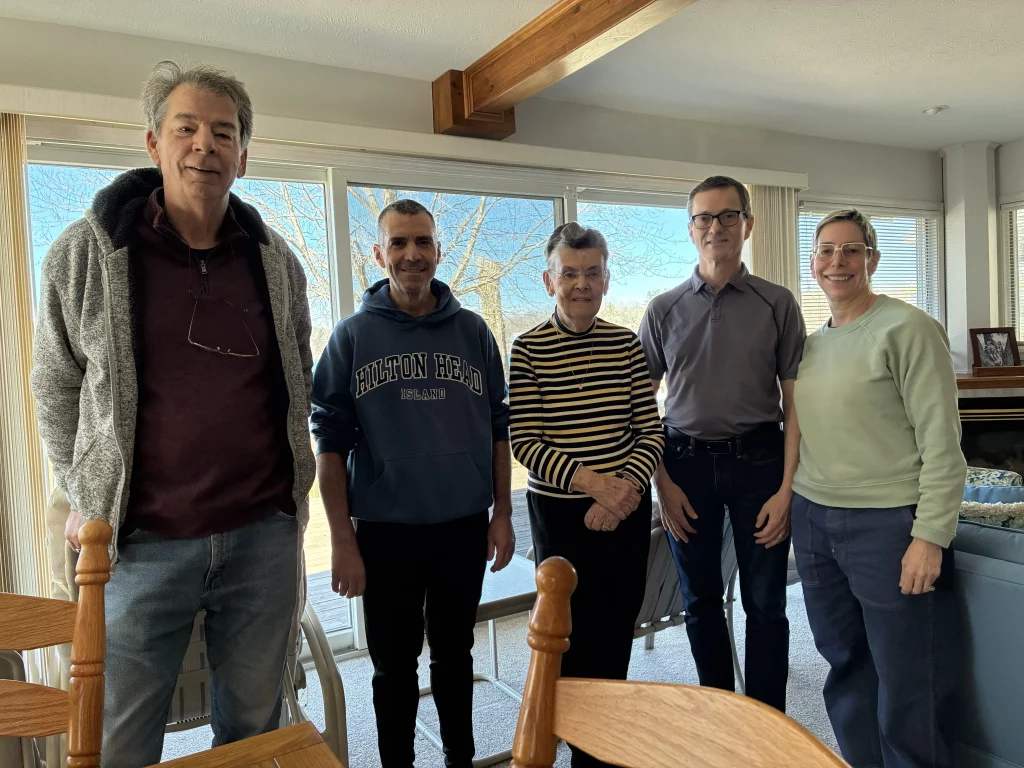
Shawn Marsh and I drove down to the Moore’s lake house in Three Rivers, Michigan the weekend of March 7, 2026 with one big question in mind: How many Murray flutes did Jack Moore make, what features did each one have, and who were they made for?
Jack’s son, Scot, and his widow, Marilyn, graciously made the trip from Indiana to Michigan to meet us at the Three Rivers lake house and show us what Jack had kept related to his craft. These materials included:
- An index card catalog of flutes and piccolos he made under his own name, their serial number, features, estimated delivery date, and recipient.
- A large binder full of correspondence with innovators including William Bennett (Wibb), Alex Murray, Albert Cooper, Tip Lamberson, Ron Lasewski, and players such as Jacques Zoon, as well as tooling diagrams and schematics.
- A second large binder filled with media articles about Jack’s success and international reach, photos from his early career at Armstrong, flute conventions, with various players and colleagues, and tributes from his many awards.
- Jack’s garage workshop, its lathes, punches, flute forms and buffers patiently waiting for a new chance to serve.
Tom Lacy, who padded Jack’s flutes (and Tom Green’s) lives near the lake house, and joined us as well.
After Shawn and I motored through a day-and-a-half of intense archiving – trying not to get lost in the many alluring rabbit-holes presented by these fascinating materials – the five of us talked for almost 90 minutes about what Armstrong was like in the old days, Jack’s work there, what led him to go out on his own, how he met the innovators whose ideas he brought to life, the flutemakers he shared ideas with, who helped him get his flutes finished and to market, and the many fine players and teachers around the world who Jack served.
the early years at armstrong
By all accounts, Armstrong was a great place to work in the early days. What started as a repair shop in 1932 – Clifford (aka Sam) Moore, Jack’s father, was the first employee – became a training ground for a generation of the some of the finest American flute makers.
Jack’s father had a workshop in the family’s garage where he did some moonlighting for other flute manufacturers in and around Elkhart. It was here that Jack learned the basics of flute making at just 12 years old.
Armstrong was Jack’s first and only employer. As the new kid, Jack was moved around to do all types of flutemaking work, and he continued to hone his craftsmanship alongside great American flutemakers such as Tom Green, Bickford Brannen and Emerson Deford, who was married to Jack’s sister.
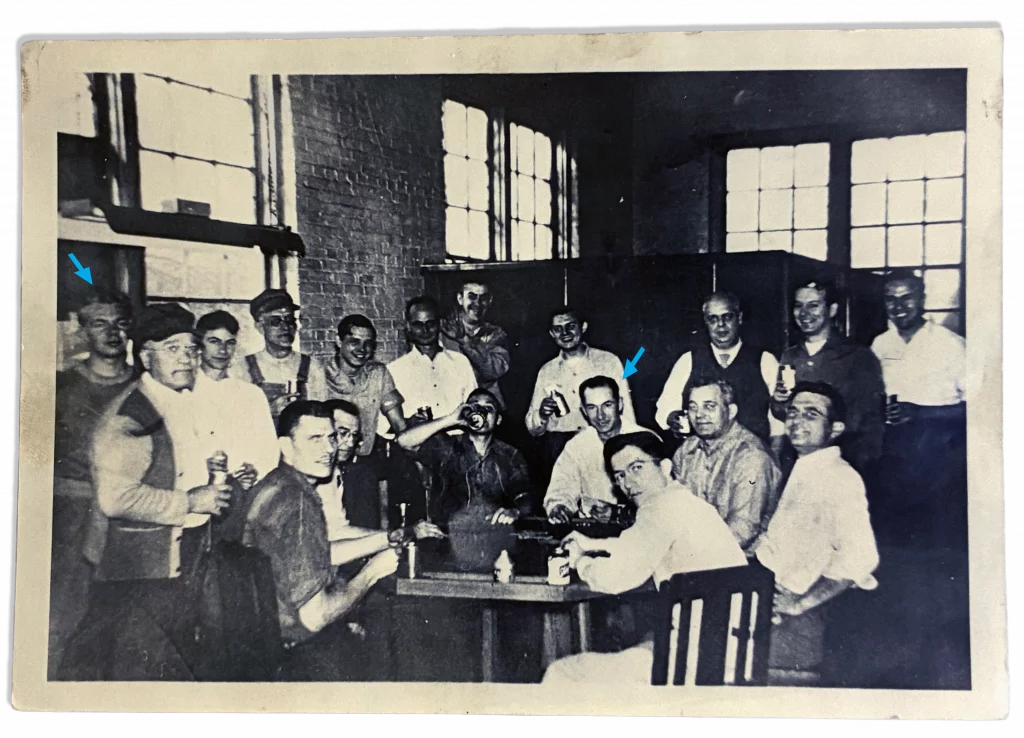
In this photo, it’s a typical Friday afternoon at Armstrong around 1948 and the staff is enjoying a beer together. Marilyn explains, “They worked during the week and then on Fridays, they always had a get-together at noon to celebrate the week.”
Tom Lacy adds that Armstrong kept a fridge stocked with beer for the craftsmen. Ah, the good old days.
Jack is on the far left, fresh out of high school, when he was hired to do bench work at W.T. Armstrong. Sam Moore, his father, is at center. Jack’s father, two uncles and two cousins worked at Armstrong too, as did Tom Lacy’s father, Bob Lacy.
putting ideas into metal
Jack mostly worked as a mounter, specializing in attaching the keywork, posts, and ribs to the body of the flute, aligning the keys and installing the rod systems and springs that allow the keys to open and close cleanly over the tone holes. He later became the foreman of the mounting department.
He was chosen to become foreman of Armstrong’s Heritage division, a new enterprise designed to compete with Haynes and Powell in the marketplace for professional flutes, which were in high demand and short supply in the late ’60s and early ’70s.
Jack’s specialty was in crafting the mechanisms needed to produce the Armstrong Heritage model, which was designed by Emerson Deford.
jack & alex meet
It was in 1967 that Jack first met Alex Murray, a meeting that would change the course of both their lives.
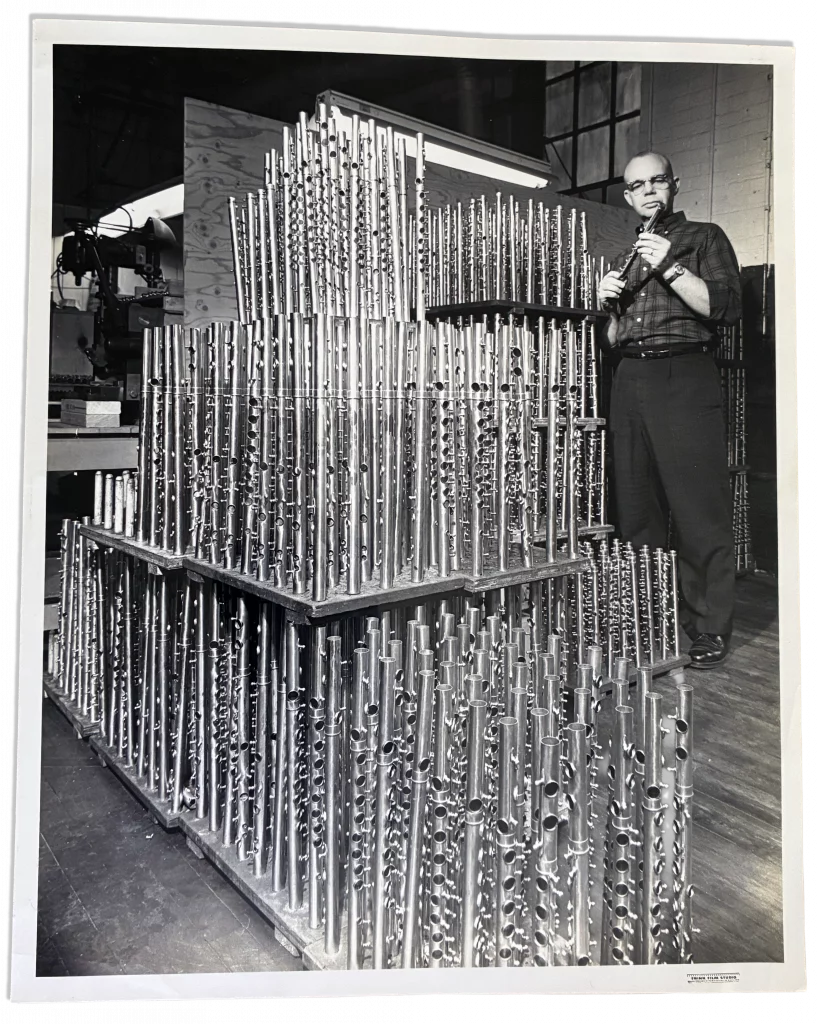
Alex had approached Armstrong to make the Murray flute, and Jack had the ingenuity and craftmanship to put Alex’s ideas into metal.
Between 1967 and 1972 Armstrong made 50 student line Murray flutes. Jack then made several silver Heritage professional Murray flutes.
Below, Armstrong Heritage Murray Flute Prototype 1 from 1971.
Alex’s need to make frequent changes and have quick results did not jibe well with the Armstrong manufacturing process, according to Jack.
Armstrong was keen to make professional line flutes at scale, and Jack was their man to do that – they didn’t want him fiddling with Alex’s mechanisms when he could be cranking out flutes.
But, according to Marilyn, while Jack was a mounter at Armstrong, “he was doing his own thing at home, and that meant from start to finish.”
“Alex kept telling him he was wasting his time. He needed to go on his own, and he said that he would see that he had orders for the first year. When Jack finally left, he had one order for a Murray flute,” Marilyn adds.
Jack didn’t want to be a cog in the Armstrong mass production wheel, but at the same time, Armstrong had been very good to him for more than 20 years and he had a wife and two boys to support. Jack’s eldest son, Scot, recalls:
“When I was two, I had pneumonia and ended up in the hospital for a week in a tent. …When I was released from the hospital, they said I needed to go to Florida for a month to recuperate. And my dad went in and said, ‘I need a month off.’ And they said, ‘Okay, your bench will be here when you get back.’ And so we went and stayed in Sarasota, which is where the White Sox training camp was at the time.”
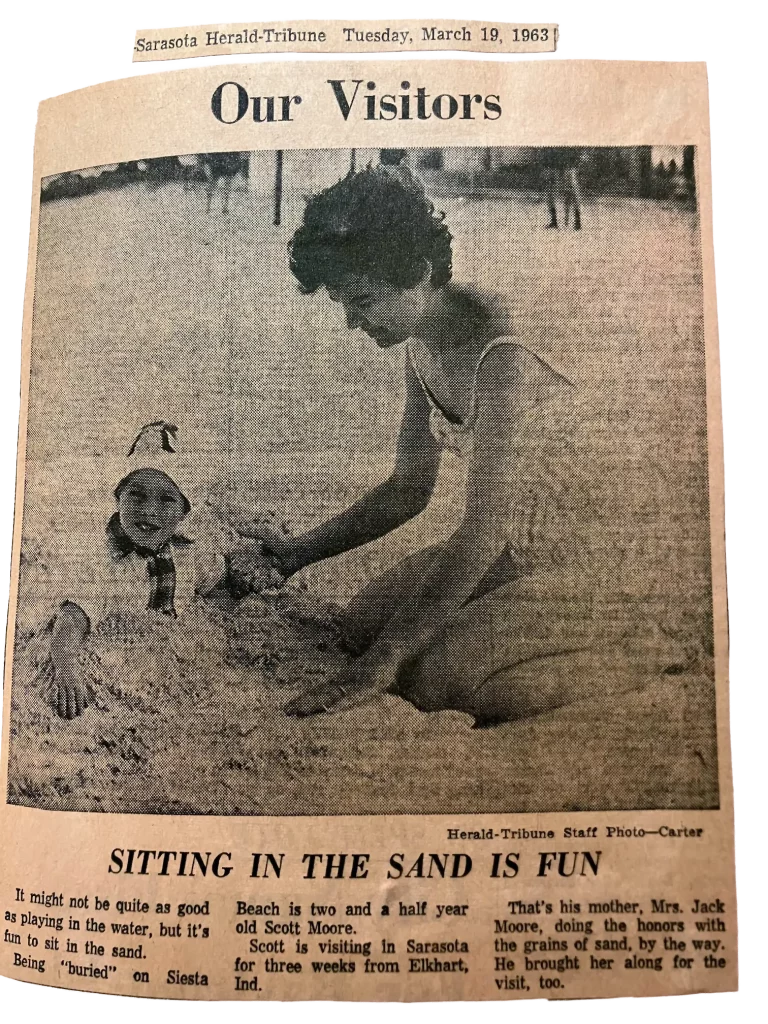
So on top of the fact that he’d lose a steady paycheck, a senior position he’d worked his way up to, and had two boys he wanted to put through college, you can understand why it was so hard for Jack to leave Armstrong, where he’d worked for 20 years or so.
But Marilyn was there to support Jack’s dream and the family. She returned to work as a home economics teacher to help with financial support and stepped up to manage the bookkeeping and administrative work as Jack’s business grew.
Armstrong had graciously offered Jack a one-year sabbatical to try going out on his own but once Jack left, he never looked back. There simply wasn’t time.
jack moore: a rising star
A star is a great metaphor for Jack, because he was at the center of so many innovators orbiting around him.
Almost all of the first 12 or so instruments Jack made under his own name starting around 1974 were Murray instruments – including 5 grenadilla wood Murray piccolos. (These instruments have roman numerals for serial numbers.)
In total, there are about 45 Murray instruments in Jack’s card catalog. We don’t know how many Murray heritage flutes he made before he went on his own. There may have been some Murray flutes he made for Alex to work out the mechanisms that didn’t get formally catalogued.
Jack didn’t like to make piccolos according to his son, Scot, and he made very few in the span of his career.
Sample of the correspondence between Jack and Alex Murray regarding the Lasewski scale Murray flute. (Link takes you to the full archive.)
“Were it not for my meeting with (Jack) some 40 years ago…my own interest in the flute would have diminished considerably in the intervening years,” wrote Alex in his 2009 tribute to Jack for his Lifetime Achievement Award from the Chicago Flute Club.
Although Jack ostensibly worked alone, sometimes spending long hours in his workshop, his flutes were finished by Paul Spencer, who buffed them, and Tom Lacy, who padded them. Tom Green, who Jack worked with and mentored, also made tools for Jack since he had access to a machine shop.
After about 6 months on his own, Jack started getting orders for all manner of conventional flutes as well as the Murray flutes. There was a moment when he and Marilyn debated about expanding Jack’s operation but Jack decided he didn’t want to do that. He wanted to continue to give each flute personalized attention and complete them in his own timeframe – which was about 2 weeks per flute.
jack & wibb meet
Jack credits William Bennett (“Wibb”) and the Bennett scale for getting his business off the ground internationally.
In the early 1980s, Jack and Wibb first met at the hospital bed of a mutual friend, Tex Richardson, whom Alex had introduced to Jack. Tex Richardson was a flute player, teacher and collector who lived in Chicago. According to Marilyn, they got to talking about flutes and Wibb asked Jack if he would build a flute for him using his own scale. Jack loved these kinds of challenges and he gladly obliged. Further, he didn’t really have his own scale.
When Jack first started out, he was using an old Armstrong scale, and he thought, a scale’s a scale; He notes in a media interview that he didn’t understand the impact the scale had on the flute until he had requests to change it.
Sample of the correspondence regarding Bennett Scale. Wibb also encouraged Jack to change his headjoint taper and finishing on the crown. Eldred Spell calculated the scale measurements for Jack’s tone hole sizes. (Link takes you to full archive.)
international renown
Jack Moore became a major name internationally in a very short time, a fact celebrated periodically in local news media profiles. At one point, he had a 300-flute waiting list. His catalog cards indicate he made about 700 flutes under his own name (the card catalog ends at 683 but begins with Roman numerals; some numbers are skipped or doubled with ‘a’ at the end). Want to see the card for your flute? Reach out.
Jack and Alex Murray also teamed up to represent the U.S. in the NFA Soviet Union Exchange in 1989. Alex gave one of his Jack Moore Murray flutes to a student of Oleg Kudryashov and Jack gave a headjoint to another grateful student, according to Alex’s report on the trip.

innovations & collaborations
Jack’s innovations, on his own initiative or at the behest of others, seem to be endless.
For instance, he pioneered a half-offset G because he thought the standard offset G was offset more than it needed to be, and because his friend Albert Cooper had created a similar half-offset G that he thought made good sense ergonomically.
His card catalogs also reveal a staggering amount of customization in the conventional flutes he made. Tubes were as thin as .012″ and as thick as .018″; tone holes drawn or soldered, foot keys were amended for short pinkies; a “lite” mechanism was offered; various scales were offered (Coltman, Cooper, Jack’s own scale, Bennett); Murray trills were requested to be put on a few standard flutes; and players’ idiosyncratic designs were put into metal.
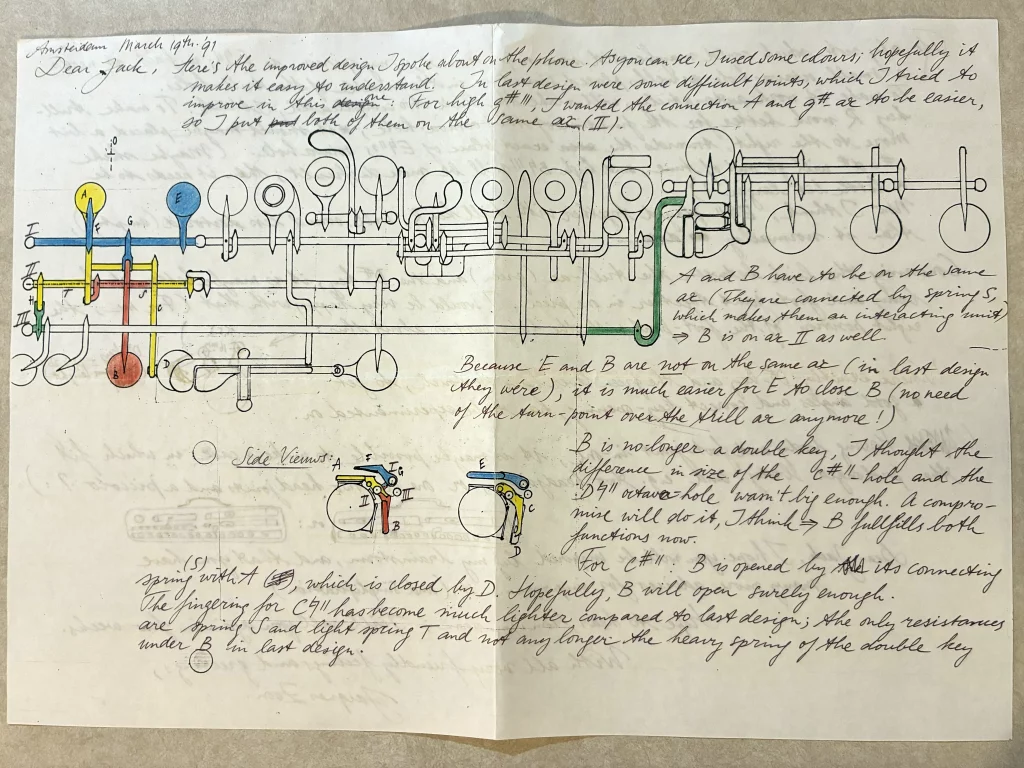
Schematics and instructions from renowned flutist Jacques Zoon.
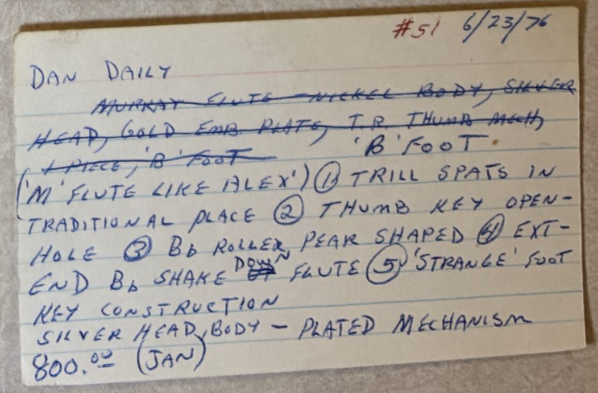
An example from Jack’s card catalog of the kind of customization he was tasked with.
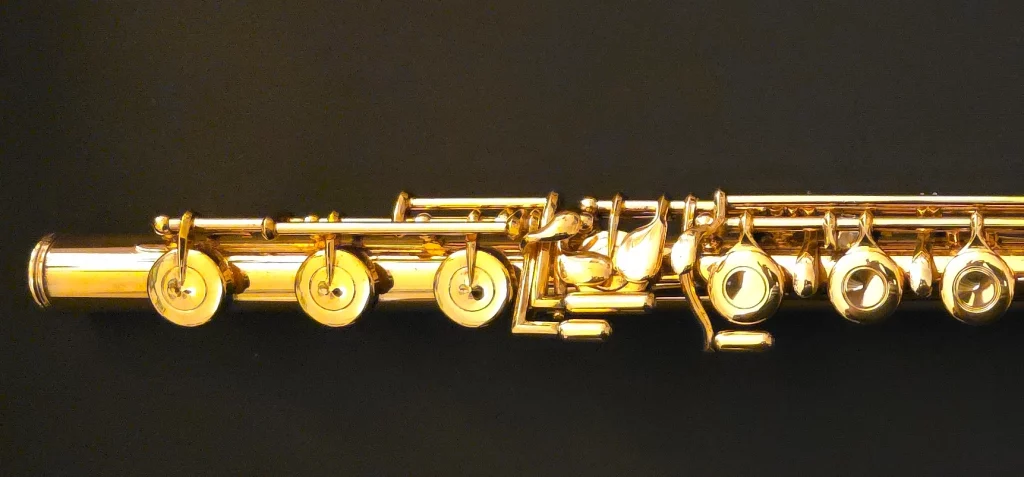
The “strange” double foot joint referred to in the index card (See Gallery for more pix of JM #51).
Jack made a cigar-shaped piccolo as an acoustic experiment for Wibb, as well as a piccolo out of a broomstick handle. The story Marilyn tells is that someone heard Wibb playing one of Jack’s flutes at a NFA convention and told him how great the flute sounded, to which Jack self-effacingly replied, “He’d sound great playing a broomstick.” As a joke, or perhaps to test that theory, Jack decided to make a piccolo out of a broomstick handle for WIBB to play. The broomstick piccolo hangs on the wall in the lake house. And yes, Wibb did play it at least once.
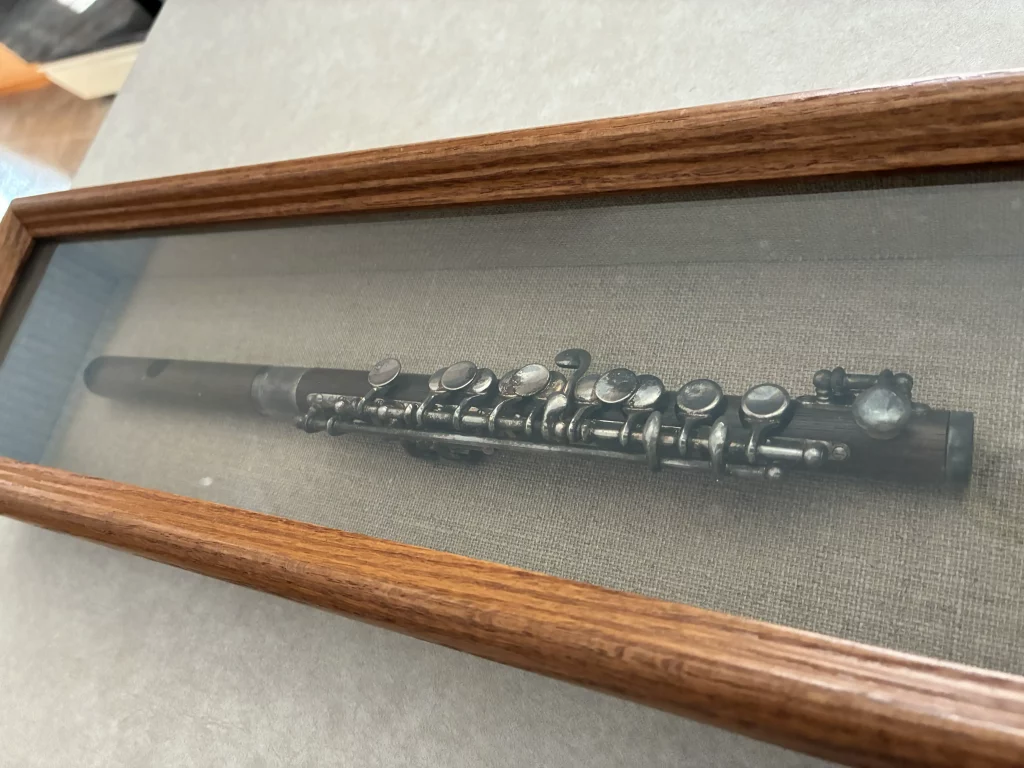
jack and colleagues
With few exceptions, this was a time in the industry when flutemakers, acousticians, notable teachers and players shared freely with each other to make a better flute.
People in Jack’s orbit for whom he kept correspondence included John Coltman, Gerald Carey, Albert Cooper, Alex Murray, William Bennett, Eldred Spell, Tip Lamberson, Rien de Reede, Wendela van Swol, Jacques Zoon and others.
Jim Keefe remembers when he was just starting out in the Brannen workshop as an apprentice and Jack stopped by to visit Bick Brannen, as the two had been friends since their days at Armstrong.
“He simply sat down and hung out with us in the workshop. He was completely open and friendly and willing to answer all our many, many questions. He was a master but treated us like brothers rather than a bunch of annoying kids who were just starting out.”
Jim and Jack got to know each other over the years at flute conventions and it was Jim who gave the address when Jack received the Chicago Flute Club Lifetime Achievement Award in November 2009.
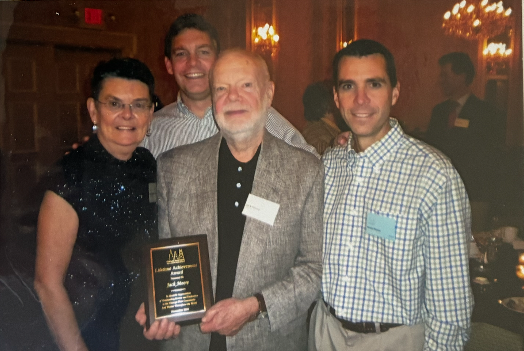
The Moore Family on the occasion of Jack’s Chicago Flute Club Lifetime Achievement Award in 2009. Just a year later, Jack was diagnosed with early onset Alzheimer’s and soon retired from flute making.
tip lamberson
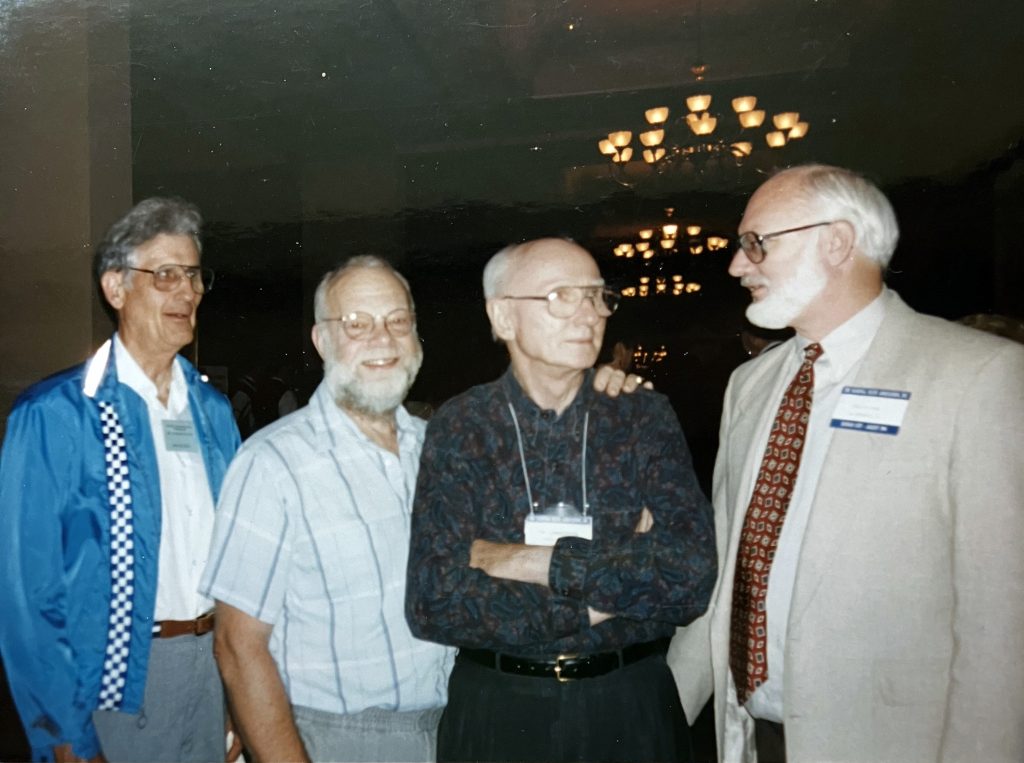
Alton McCanless, Jack Moore, N.D. “Tip” Lamberson at an NFA Convention.
Alton McCanless was a player who in 1967 began building flutes with Tip Lamberson. He handmade some 500 Lamberson flutes before striking out on his own in 1979. He built about 150 McCanless flutes.
Tip Lamberson was a good friend of Jack’s with whom he exchanged ideas and experimented. To that end, there are 11 flutes Jack made that were cobranded as Moore-Lamberson collaborations in which Jack made the headjoint and tubing and Tip made the mechanism. (These do not appear in his card catalog). The first, #383, features A=442, Bennett scale, closed hole, C foot, offset G, split E, split F#, and a Brossa F# key, which is located above the third finger key of the right hand.
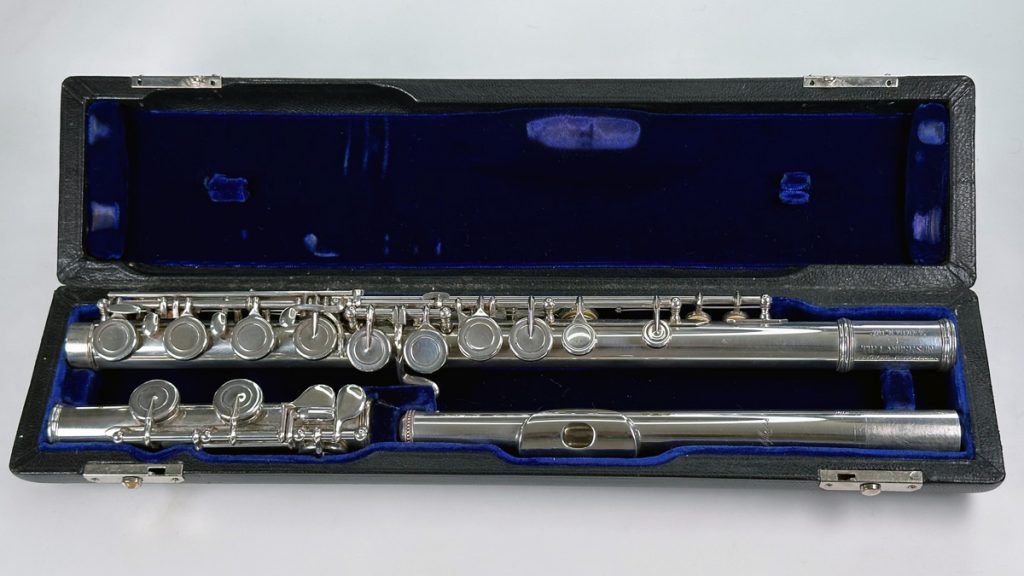
Moore-Lamberson #383, courtesy of Gary Lewis Flutes.
albert cooper
Albert Cooper and Jack met early on at an NFA Convention and maintained a long friendship, sharing ideas and visiting one another.
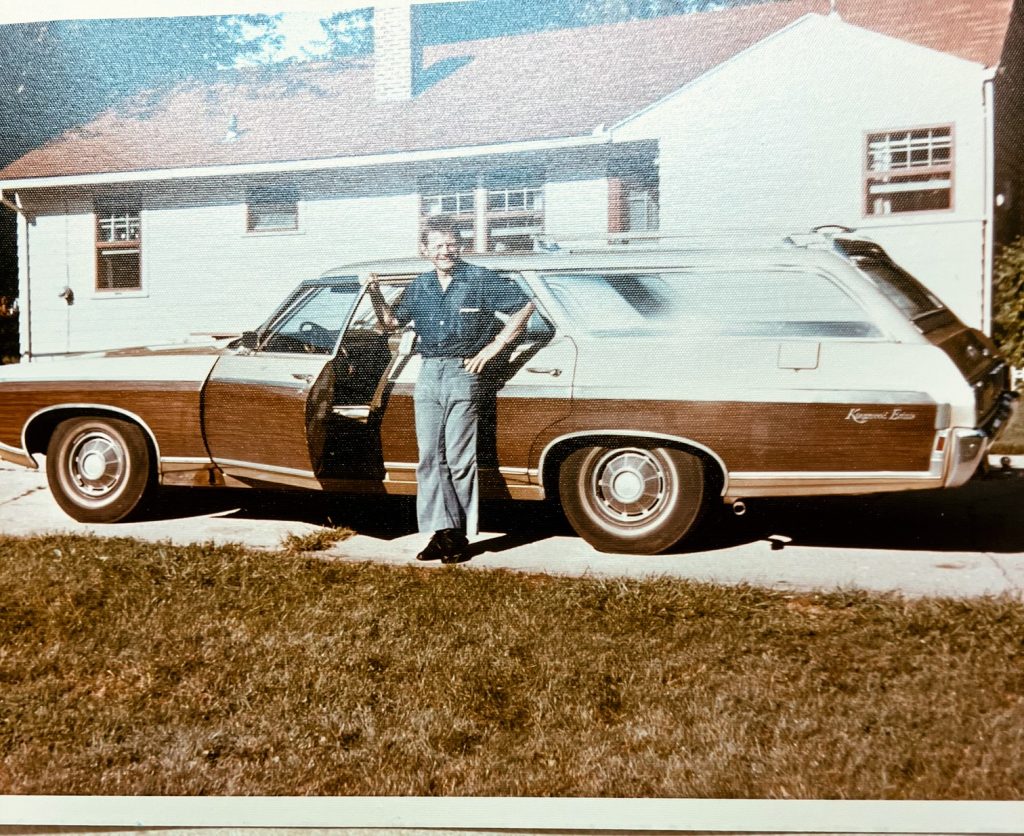
Albert Cooper outside the Moore’s Elkhart home. According to Marilyn, Albert was amused by the size of Jack’s station wagon, noting it was almost as big as the house, a fact that most certainly merited a Polaroid for the folks back in England.
Examples from the correspondence Jack kept between he and Albert Cooper and a photo taken in 1995.
tom green
Jack and Tom Green had a long and fruitful relationship. Tom got to know Jack better when he started making Murray flutes at Armstrong. He had a machine shop and made tooling for Jack as well as David Wimberly early on.
Jack with Tom Green and Wibb.
friendships with players and teachers
Flutist and teacher Wéndela C. van Swol is another who maintained a long relationship with Jack and Marilyn. Many of Jack’s gold “lite mechanism” flutes went to her students in Spain and she worked at their booth at various NFA conventions starting in 1996.
Jack cherished his relationships with players around the world. He and Marilyn visited players with whom they forged relationships, visiting them in Germany, Italy, the Scandinavian countries, The Netherlands, Canada and Mexico. Other players came to Jack’s workshop to pick up their flutes, and perhaps enjoy a little fishing with Jack on the lake.
Wéndela recalls: “I knew of his exceptional craftsmanship and affordability through my former teacher and soloist of the Royal Concertgebouw orchestra, Paul Verhey.
As I knew there was a waitlist, therefore I asked him to place the order for me…
I waited less than a year and when I was notified that my flute was ready, other JM flutists in the Netherlands told me that it would be best to go personally to pick it up and choose a head joint. And that’s what I did and that’s how our long lasting friendship started.”
Wéndela working at Jack’s booth at a flute convention, and visiting with Jack in his later years.
jack's workshop
It’s hard to fathom how Jack used these clunky machines to make such beautiful flutes. The workshop equipment was only recently sold.