
early years
Alex Murray graciously provided us with articles (some annotated) and photographs drawn from Armstrong News, The Amis Newsletter, The instrumentalist, The Music Journal and The Galpin Society Journal that covered the early development of the Murray Flute. This collection of articles and images, including those written by Walfrid Kujala and Philip Bate, has been scanned into a PDF and can be downloaded or viewed in entirety here.
Here, in his own words, is Alex’s rationale for the Murray flute and a synopsis of the ways it differs from the standard flute:
Open G#
- The duplicate g# hole was unnecessary.
- The spring of on open key is lighter than one required to hold the key closed.
- Top e is greatly improved when correctly vented with the a hole alone, and not the a and g# holes together as on the closed g#.
- One finger one key (pad) on g.
I consequently asked a flute repairer to alter my instrument to the open g# and after a few weeks practice I found the readjustment amply rewarded.”
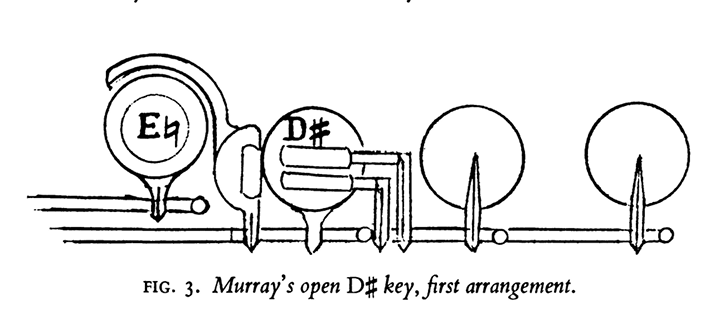
Open D# foot and D crescent
“The assymetrical use of the little fingers, in particular the necessity for maintaining the right little finger down much of the time struck me as undesireable and I experimented with an open d# by turning the foot-joint until the d# hole was within reach of my little finger. I unhooked the spring and maintained the key open with an elastic band. The flute became a little unstable to balance but I solved this by sticking a wedge of cork on the body above the right thumb. (I no longer require this crutch, having learned to balance the instrument without it.) I felt that the action of the key was an improvement on the closed d#.
At that time I was fortunate in meeting Albert Cooper, on artist-flute-maker, formerly of Rudall Carte who had left them to begin making flutes on his own. He agreed to construct a new foot joint which would convert my flute to open d#.
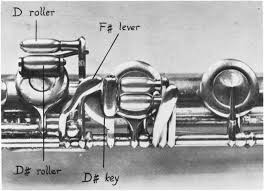
The c#, d, and d# holes were placed in line from an axle on the near-side of the flute; the d# key was closed by both of the other keys. The problem remained, how to trill c-d or c#-d. When the little finger was removed from c or c#, d# was the note thot sounded. In order to circumvent this, a crescent-shaped key was buiIt from the d key around the front of the ring-finger key. (I still use this mechanism on the piccolo.) This finger could then close both keys simultaneously when required, giving d#.
Later it was found better to have two parallel rollers so that the ring finger could move easily from d to d#, in the same way as the little finger moves from c to c# on a flute with two rollers on the foot- joint.”
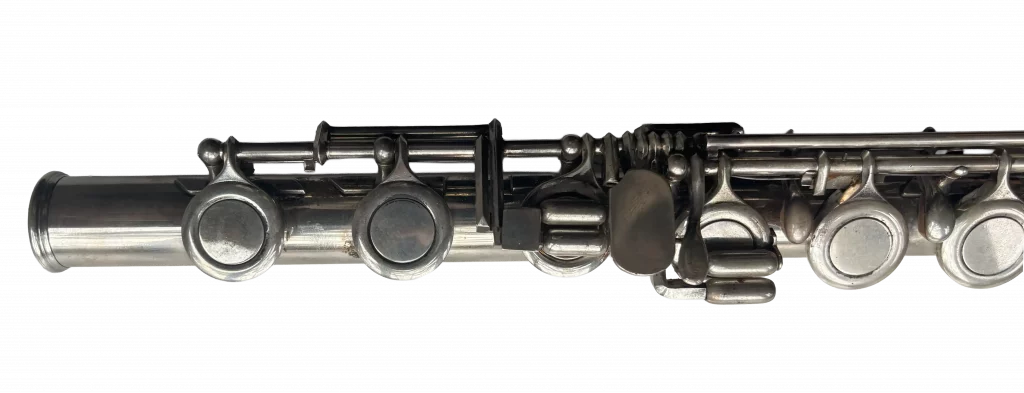
Foot joint detail from an early Albert Cooper Murray flute, courtesy of Leslie Timmons.
F# touch
“Once above d, the little finger is only required for d on octave higher. This led to the construction of a little finger key for f#, with several advantages. When f# is fingered in this way, alI holes below the f# hole ore open. A good trill for e-f# is provided with no change of fingering (for f#) and by splitting the a key (so that the b hole can remain open when the bb hole is closed) and connecting the lower key to the f# lever, the correct venting for top f# is mode practicable (comparable to top e on the open g#).”
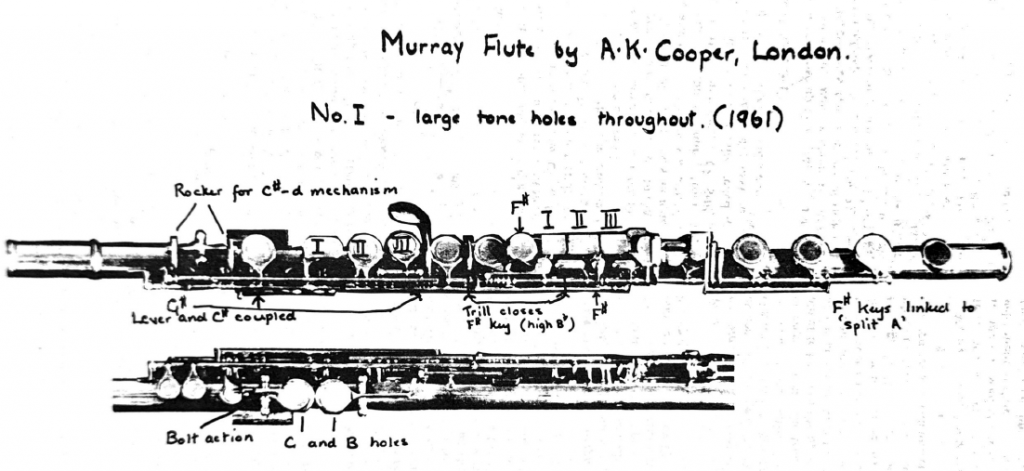
Small C# hole
“The other notes which needed improvement were those using the small c# hole. The multiple functions of this hole are:
- a tone-hole for c#2 , 3, and 4
- a vent-hole for d2, 3, 4, d2 g#3 a3 bb
As Boehm pointed out, some compromise in its size and position is inevitable.
On many flutes the interval c#-d#2 requires careful blowing to produce a whole-tone acceptable to the ear (c#2 has to be flattened and d#2 sharpened, an unhappy juxtaposition of compensations). After several experiments a relatively simple mechanism was devised to divide the functions between two holes – a large c# tone hole and a small d vent. This entailed no change in the fingering apart from the reversal of the Briccialdi thumb keys and a return to the more rational order originally used by Boehm (b natural nearer the head joint).
The necessity in the top octave of putting down the right little ring finger for top b was obviated by linking the lower trill key to the d key. This automatically closes the d# hole when b is fingered normally. The effect on the trills is unnoticeable.
With these slight mechanical and fingering changes it has become possible to construct instruments with the hole placing correctly determined by the use of Boehm’s schema, without compensatory shifts of hole position to humor “bad” notes.”
Albert Cooper & Jack Moore
“Without the skill, patience and insight of Albert Cooper, this flute would not be in existence. Inevitably he has been inundated with work and has a seven-year waiting list for his instruments. I have been most fortunate in meeting those responsible for manufacturing Armstrong flutes. The foreman, Jack Moore of the Heritage division, accepted the challenge of making a similar flute with certain slight mechanical improvements over my present one (my eighth) which I hope will embody the final form of the Murray flute. The following is on exact reproduction (in reduced form) of the Schema and fingering chart; also follows his data regarding the above story.”
(Please see Jack Moore’s schematics and notes in the PDF file here, pp 4-5.)
By 1974, Jack Moore had already made more than 50 Murray flutes. Alex and Jack first met after Alex reached out to Armstrong in the interest of having a student line Murray flute manufactured. Around this time, Jack went to visit Albert Cooper in England for about three weeks. According to Jack’s widow, Marilyn, the two men had met at various flute conventions and shared a passion for flute making that resulted in a lifelong friendship. In those days, flute craftsmen helped each other by openly sharing techniques and innovations. Jack maintained that stance his entire life.
Murray adds in his notes, “Jack Moore has been responsible for many major and minor improvements to date. He produced two prototype flutes (the second of these was played at the Amis Convention in Washington, April 15-16, 1972 -ed.), fifty school model instruments, many with slight modifications, a Heritage silver flute, shown at the Amis convention Spring 1974, and is currently making a white gold model for the August National Flute Association Meeting.”
Student model Armstrong Murray flute, courtesy of Pat Zuber
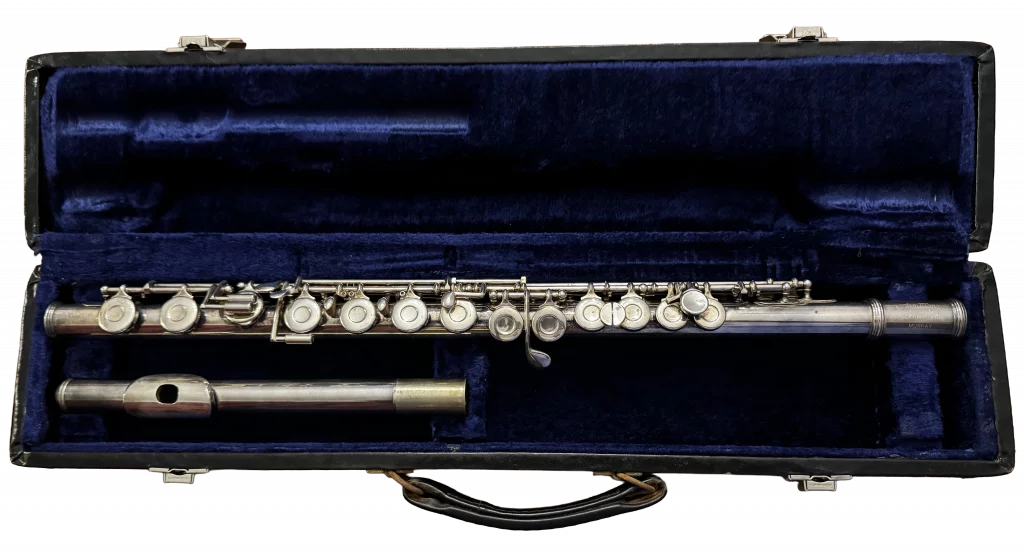
Professional Armstrong Heritage Murray flute, courtesy of Leslie Timmons

Armstrong Murray Prototype I, made by Jack Moore in 1971, from the cover of the American Musical Instrument Society Newsletter, Vo. 1, No. 3, June 1972.
Perhaps it goes without saying there were many more modifications to come in the ensuing years. Tom Green, who worked with Jack Moore, recalls:
“Alex would send Jack diagrams on his vision for a flute that he thought would improve the traditional fingering. Oftentimes Jack would have to call Alex to explain what he was trying to accomplish. It is one thing to draw something out and another to be able to integrate it into a workable mechanism. Our biggest joke was that Alex would write, “This is the last change.” We would say, yeah, right, and laugh.”
The Murray-Moore mechanism has seen dozens of iterations over more than 50 years of development, influenced by physicists and mathematicians including Arthur Benade, Elmer Cole and Ronald M. Lasewski, as well as the craftsmen who made the flutes.
In addition to Jack Moore, other fine flute craftsmen who made Murray flutes included Tom Green (who had access to a machine shop and made tools and mandrels for Jack Moore as well as assisting him); David Wimberley; the Brannen workshop; Keefe (currently making a Murray piccolo); and most recently, Juan Arista, who made a Lasewski scale headjoint in 2025 (and currently has the mandrel).
In addition to the very early Murray prototypes made by Armstrong intended for students a silver Murray piccolo was made as well. Murray wood piccolos were among the first instruments Jack Moore made when he left Armstrong and went on his own; the serial numbers are in roman numerals, which Jack abandoned after the XIII piccolo made around 1977. Murray alto and bass flutes were made by Emerson, and an experimental quarter-tone Murray flute was made by Kingma. There’s also a multi-option Murray flute resulting from a collaboration between Jack Moore and Robert Dick. Jack Moore, who died in 2018, and Tom Green, now retired and in his 80s, are the only craftsmen to have made Cooper scale, Coltman scale and Lasewski scale Murray flutes.
We have been in touch with Jack Moore’s widow, Marilyn, and now have a database of all the flutes Jack made. If you acquire a secondhand Jack Moore flute, Murray or otherwise, please reach out with the serial number and we will forward the details Jack noted about your flute in his index card catalog.
The Sound of a New Flute
You’re probably wondering by now what the Murray flute sounds like.
Below are a few of the many recordings featuring Alex Murray on flute with the London Symphony Orchestra, where he played Principal for 11 years, from mid 1955-1966. Pierre Monteux’s tenure as Principal Conductor of the LSO (1961–1964) and his earlier guest appearances produced some of the most celebrated recordings of the stereo era, primarily for the Decca, Philips, and RCA labels. A select few are featured below. The flute duet with Joan Sutherland on Lo! Hear the Gentle Lark is truly masterful, matching trills and vibrato to Sutherland’s huge voice.
In 1973, Alex Murray made the first solo recording of the Murray flute: The Bach Partita (Lute Suite) in C minor for flute and harpsichord coupled with a hitherto unrecorded Duo Concertante by Carl Czerny for flute and piano. The keyboard player was Martha Goldstein and the recording engineer Alan Goldstein, a Peabody graduate on flute. These recordings and many more of Alex Murray and Martha Goldstein are shared courtesy of Wikimedia Commons.
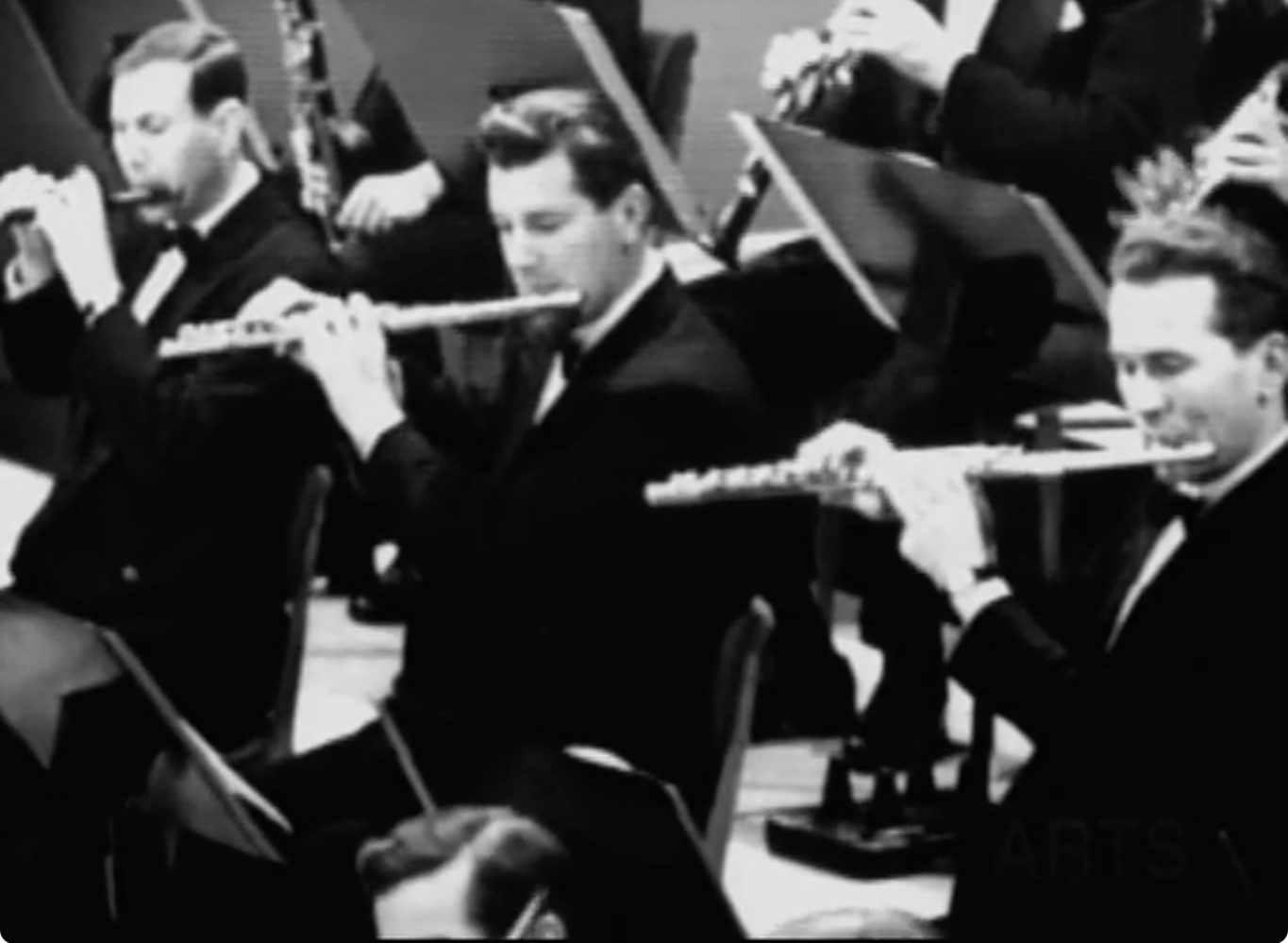
An image from the live recording of the LSO playing Dukas' The Sorcerer's Apprentice. Check out how still the wind players and brass players are during the performance. Left to right: Lowry Saunders, Richard Taylor, Alex Murray,
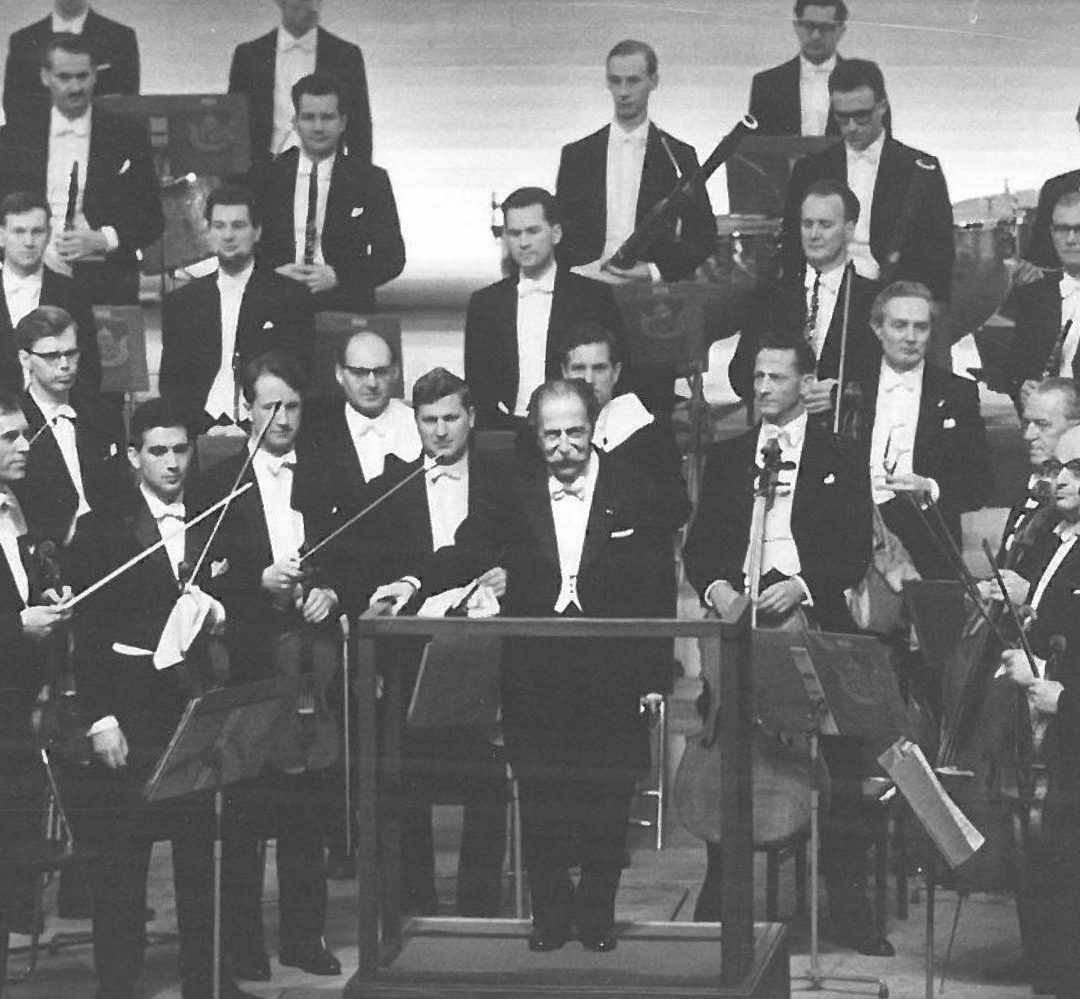
The LSO led by Pierre Monteux captured on tour in Japan.
Czerny Duo Concertante
1.Allegro
2. Scherzo-Allegro Molto
3. Andantino Grazioso
JS Bach BWV 997 – Partita No. 2 in C minor
1. Prelude
2. Fuga
3. Sarabande
4. Gigue
1990s - 2004: The Finale and a new scale
In the models made before the 1988, Alex sought to make a flute with hole placings and dimensions pursuant to Boehm’s ideal schema and without the need for compensatory adjustments to humor “bad” notes. He often stated his goal was to make the flute Boehm dreamed of making.
The problem wasn’t Boehm’s scale, but rather, the change in the tuning standard. Boehm’s flute was made to play at A=435 Hz. When orchestras changed to A=440 Hz, (recommended in the 1930s and officially codified by ISO in 1955), headjoints were shortened and the scale suffered as a result.
In the 1990s, when Alex adopted the Lasewski scale for his flute, that rubric changed. Lasewski scale necessitated significant changes in the placement of the tone holes as well as a very specific head joint that was more tapered up top, akin to a baroque flute, and slightly longer as well.
Ron Lasewski explains how and why the work began:
“As you know, Alex experimented with the key mechanism and tuning of the modern flute over a period of many years. This work resulted in the Murray/Cooper-Coltman-scale (MCC) instrument of the early 1980s. There were some remaining issues with this instrument, in particular a difficulty in keeping the uniformity of sound-quality or tone-color from note to note in the scale without sacrificing tuning and having to make substantial physical changes in the way the flute is played.
I was interested in historic baroque flutes. I measured many extant examples of these instruments, and it was clear that there was nothing like a standard in pitch, in bore dimensions, in tuning, or in sound-quality. In order to have a basis for comparing the behavior of the various examples, I developed an analytic pitch-independent way to compute the harmonic structure of each instrument. Comparisons among physical dimensions, the actual quality of played notes, and the corresponding harmonic structure made it possible to design ‘optimized’ historic reproductions within the confines of the range of variation found in the actual dimensions of historic examples.
Talking with Alex about the issues with his MCC flute, it seemed that it might be interesting to explore the harmonic-alignment of that instrument using a modification of the baroque-flute code. This resulted in a number of experiments addressing particular aspects of the MCC’s performance. These involved making simplified head joints consisting of cylindrical steps of various lengths and diameters for ease of manufacture (step-heads). These were not intended to be ‘real’ head-joints.
[I should make a note here about the Roman-numeral identification system that I use: the numeral is a sequential project number. It can refer to a calculation, a design, a manufactured head-joint, or a manufactured flute.]
Projects I to X (1986 to 1987) involved step-heads designed to alter aspects of the MCC’s behavior.
Project XI (1987) was a theoretical analysis of a step-to-smooth bore transition.
Project XII (1987) was a smooth bore head tailored to the MCC flute.
At this point it was clear that the MCC scale was a limiting factor and that progress would require that the whole instrument – head and scale – be redesigned.
Project XIII (1988) Design a smooth bore head that could be overblown to play a series of true harmonics.
Project XIV (1991) Develop theory and code to design a new scale using head-joint XIII.
Project XV (1994) Design three new flutes using head-joint XIII.
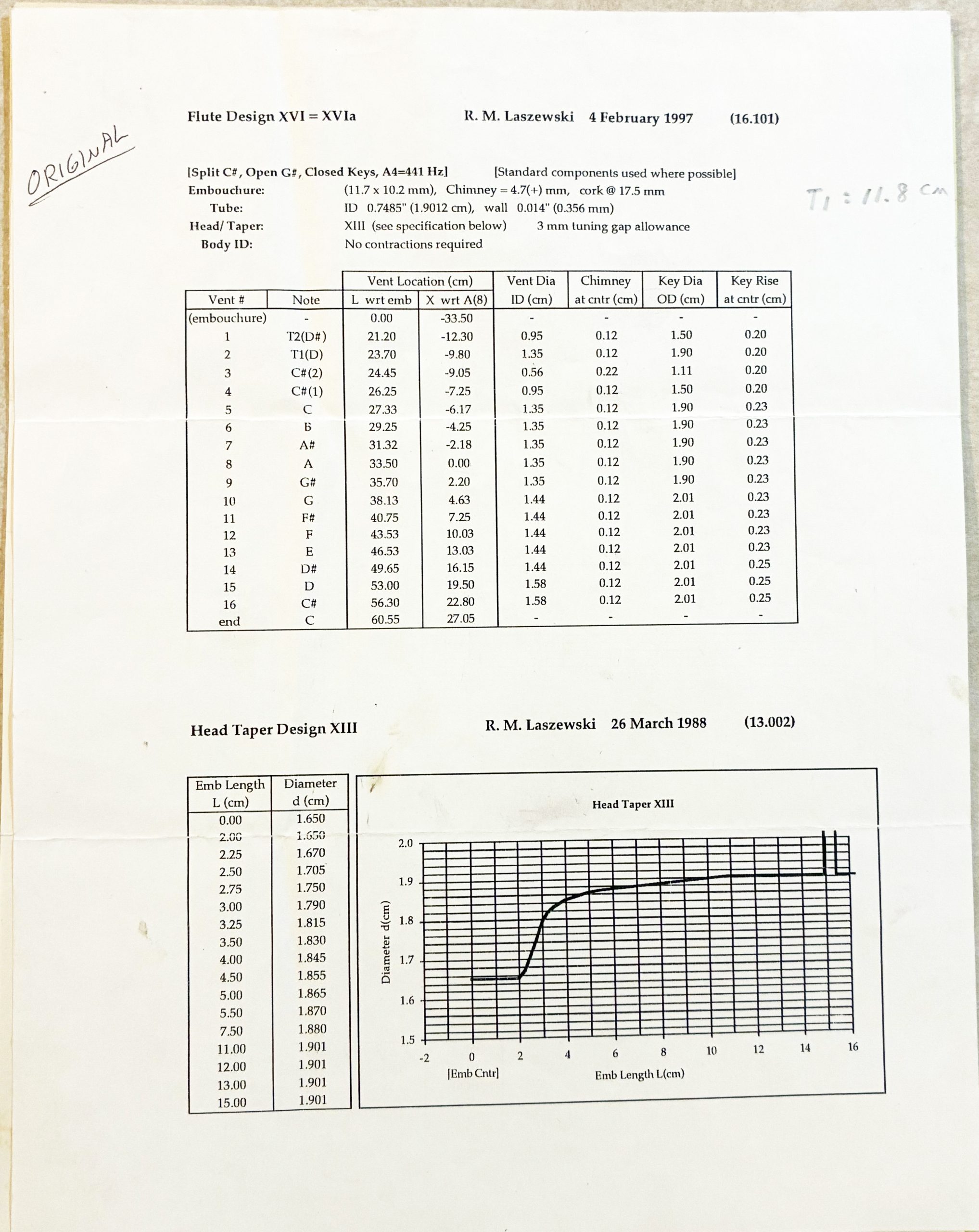
Flute XVa: split C#, open G#, closed keys, A4 = 442 Hz. This is the Murray-system/Laszewski-scale flute (ML). Note that at room temperature, the head is designed to be pulled out by 3 mm to allow for some pitch adjustment at lower temperatures.
Flute XVb: split C#, open G#, open-keys modification. Note that a contraction in the bore of the body is required. This can be achieved with an appropriate insert soldered into the cylindrical bore.
Flute XVc: split C#, closed G#, open keys modification. Note that a contraction in the bore of the body is required.”
A final iteration followed: Flute XVI – used for the 1998 Tom Green flute and Alex’s Finale in 2004. This was required after Alex made a change to the placement of the C# hole, described below in Ron’s quote.
About Ron Lasewski
Ronald M. Lasewski was a mathematician/physicist, Baroque flute enthusiast, and longtime colleague and friend of Alex Murray during his time teaching at the University of Illinois, Urbana. Lasewski wanted to know what physical characteristics made his Baroque flutes sound the way they did. He studied their acoustic characteristics — especially, the distance between the first and second partials and the third and fourth partials of each note — and recorded corresponding physical measurements.
Over time, he programmed a computer to model what the acoustic result would be in pitch and timbre to any physical adjustment to hole size, placement, venting or bore dimensions. He made some thirty-odd Baroque flutes using his “Traverso” program, studying and learning from the results.
Now applied to Alex’s flute in C, the program’s ability to predict how one change to the flute could affect every note in the range took Alex light years ahead in his ability to experiment for optimal results. Even with the aid of Traverso, it still took 13 tries to make the Lasewski scale tapered head joint, according to Alex.
Ron Lasewski recalls: “The goal in all the acoustic design work was to align the higher harmonics of any played note so that, in addition to the note being in tune, the partials fall in a true harmonic series without intra-harmonic dissonances. A measure of this is the ease with which an instrument ‘breaks’ across octaves. Alex must have demonstrated this many times.
Unlike the case with other head joints, you will notice that if you play the head joint XIII by itself, you will get a true harmonic series. The design of the body is such as to impedance match this characteristic to all the played notes.
The original XV design achieved this. But, at a certain point, in the process of revising his key-work mechanisms, Alex decided that the split C# positions needed to be moved. In XV the respective diameters were 0.752 and 0.752. In XVI they would be 0.95 and 1.35. Accommodating this change also would require moving the positions of many of the other vents – if the performance of the instrument were to be maintained.
To test the C# mechanism change quickly, Alex had Jack patch (the) XV (prototype) and just re-do the C#’s, without changing the other vents. Your ‘XV’ (prototype) is actually something of a kluged hybrid, so it’s not too surprising that it doesn’t play as well as the complete XVI design does.”
Top, Standard headjoint (David WImberly); Bottom, Lasewski scale Murray headjoint (Juan Arista)
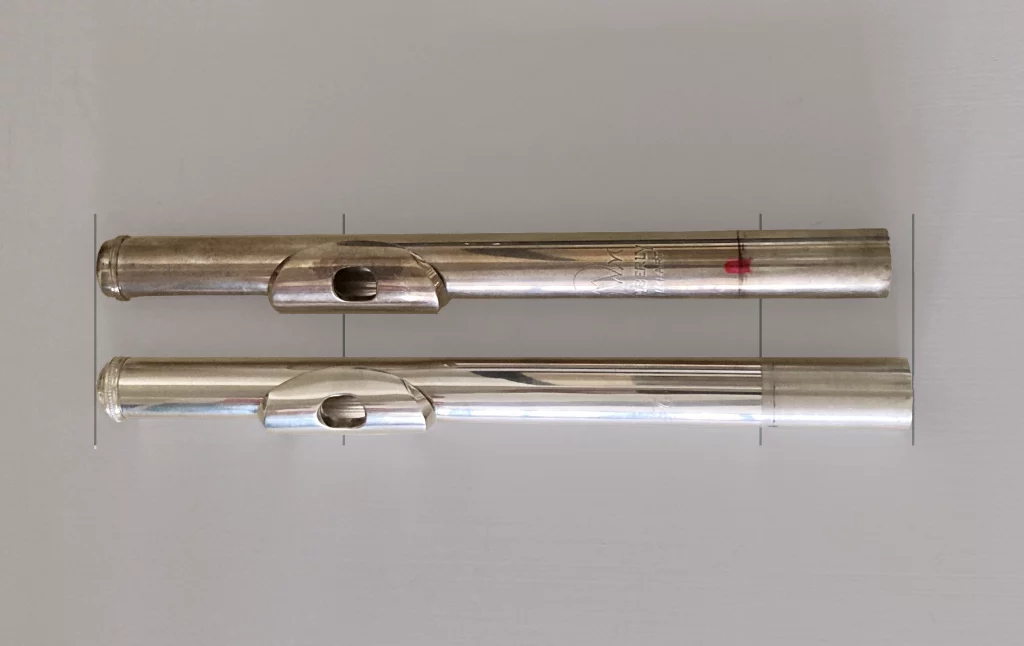
Note how much narrower the Lasewski scale head is at the crown side; the distance to the center of the embouchure holes from the cork; and the length.There is a special mandrel used to create this headjoint, Juan Arista has it.
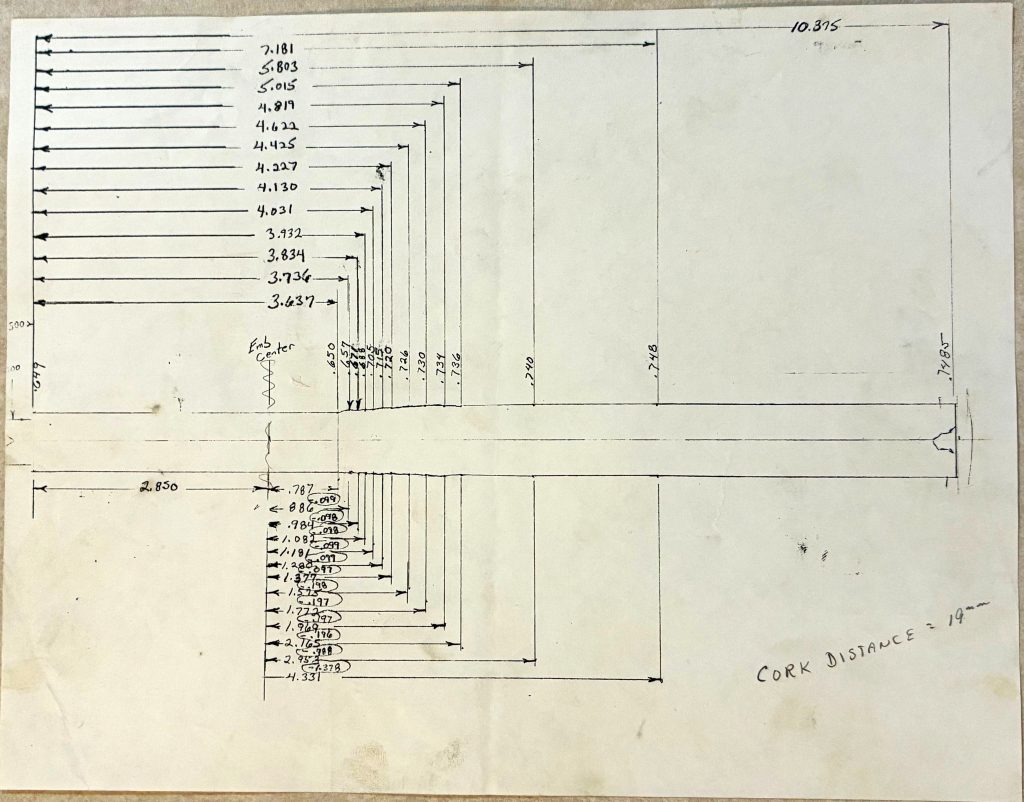
Below, one of the schematic renderings of an early stepped headjoint design from Jack Moore’s archive.
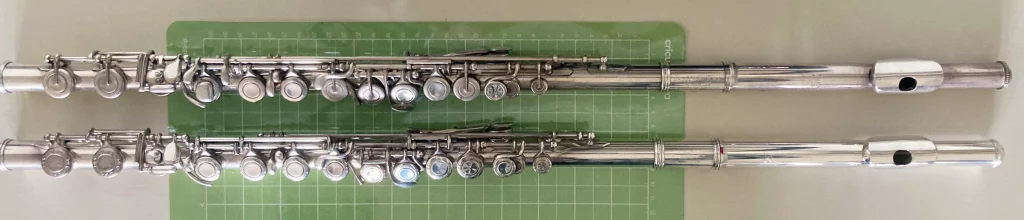
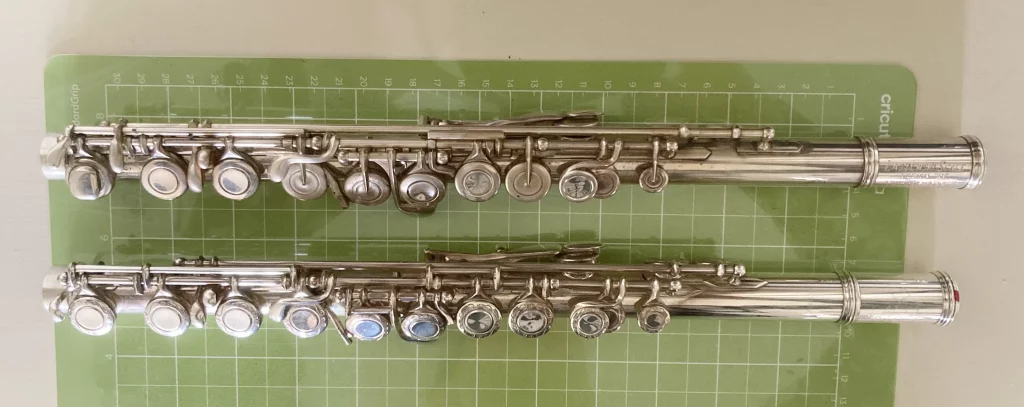
Below, the Lasewski scale prototype XV made by Jack Moore (top) with the patch C# and the XVI Tom Green made 4 years later, in 1998. They look similar but the hole placements, hole measurements and bore size are different. The XV has a longer body and shorter head than the XVI. The XVI plays much better, especially in the low register.
Key Differences
If you try to play the Murray Lasewski scale flute with a standard flute head joint, it may fit into the body of the flute but it won’t work. The acoustic problems will manifest in the extremes of range, both low and high. (Juan Arista currently has the mandrel Tom Green made for the Lasewski scale headjoint).
This is entirely subjective, but having played Murray flutes with both scales, I note that you cannot push as much air through the Lasewski scale flute – but the good news is, you don’t need to! It’s an incredibly resonant instrument. Find the sweet spot and it almost plays itself. From a fingering standpoint, I did not feel the changes made to placement of the tone holes underhand. There are a number of alternate fingerings specific to the Lasewski scale models that you can explore here.
The Lasewski scale models add another important feature to the Murray-Moore flute: a half-hole mechanism that brings the top octave in tune. It can be switched on and off with a tiny lever.
In a note enclosed with the XV prototype, Alex wrote:
“The switch on the F# key is needed to trill F#-G#. When it is on it flattens high Eb. The amount of venting on top octave can be adjusted to suit. On the latest flute the G# cover is independent of the G# key so that the key does not move the the F# link – about the only difference.…
The Rockstro F# is possible because high B no longer needs a trill key. It is on this flute (added in easiest – not best mechanical way) – Can be used with a closed D# foot if I send one to you…
The head cork is not normal distance – it is 17.5mm. If you move it you wreck the harmonic alignment. Playing from G up (to D) the C# key can stay down to simplify matters – doubtless you’ll find some other fingerings.”
These models go down to low C only and employ closed hole keys for acoustic reasons. In the Lasewski correspondence, it is clear that open holes would have required slightly different hole positions for certain keys.
Until the very end, Alex continued to make small modifications to his mechanisms.
In the last flute Alex had made in 2004, the body was merged with the foot joint and the D crescent was placed just atop the D# key cup (instead of around it) with a bit of felt in between and a slightly raised button of silver on the D# key cup, presumably to slide between D and D# with less movement of the ring finger. This raised button is also seen on the 1994 Lasewski scale prototype but it’s paired with the standard D crescent. The 1998 Tom Green Lasewski scale flute does not have Rockstro F# between E and D# or the raised button on the D# key and the D crescent is in its usual place, hugging the exterior of the D# key and adjustable by the player.
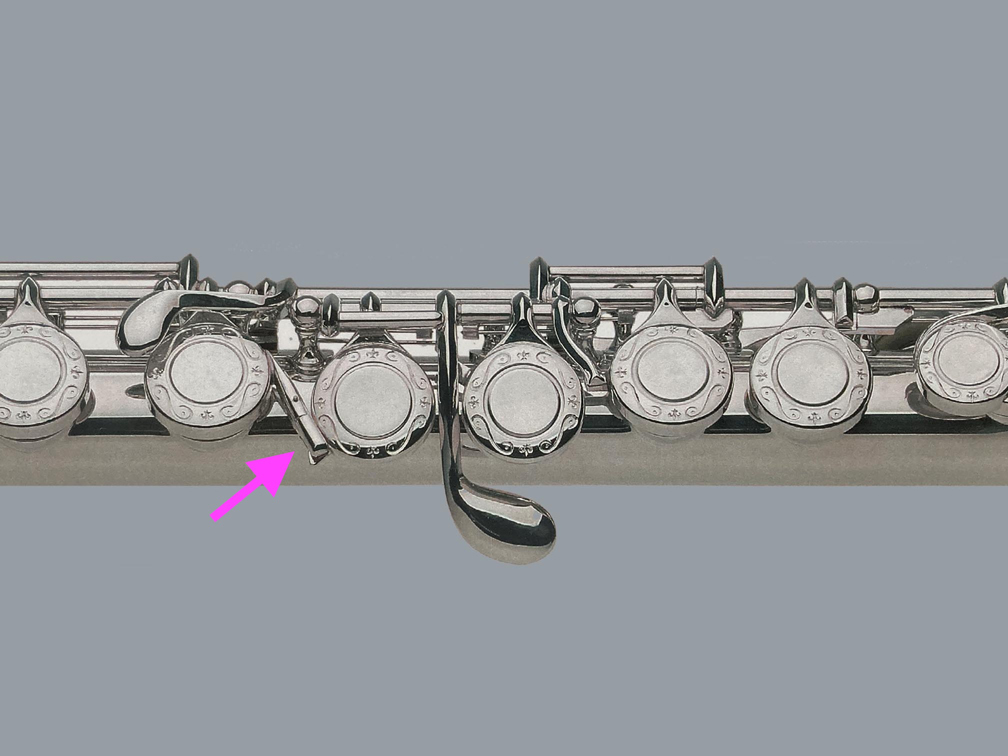
1998 Tom Green Lasewski scale XVI flute with half-hole mechanism in "on" position.
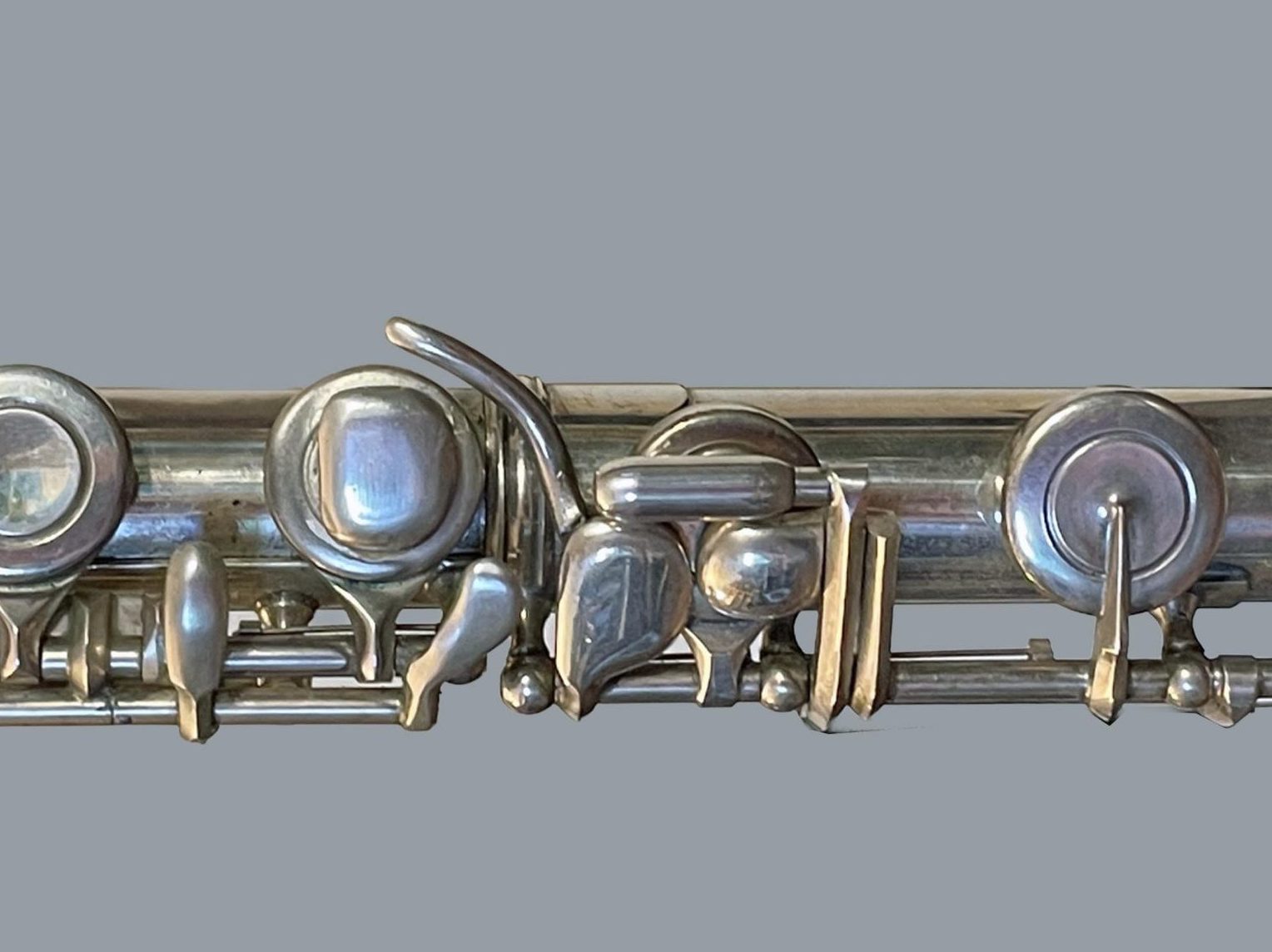
1994 Jack Moore Lasewski scale XV prototype with raised D# and a Rockstro F# key between E and D# cups (as on pre-Lasewski scale models).
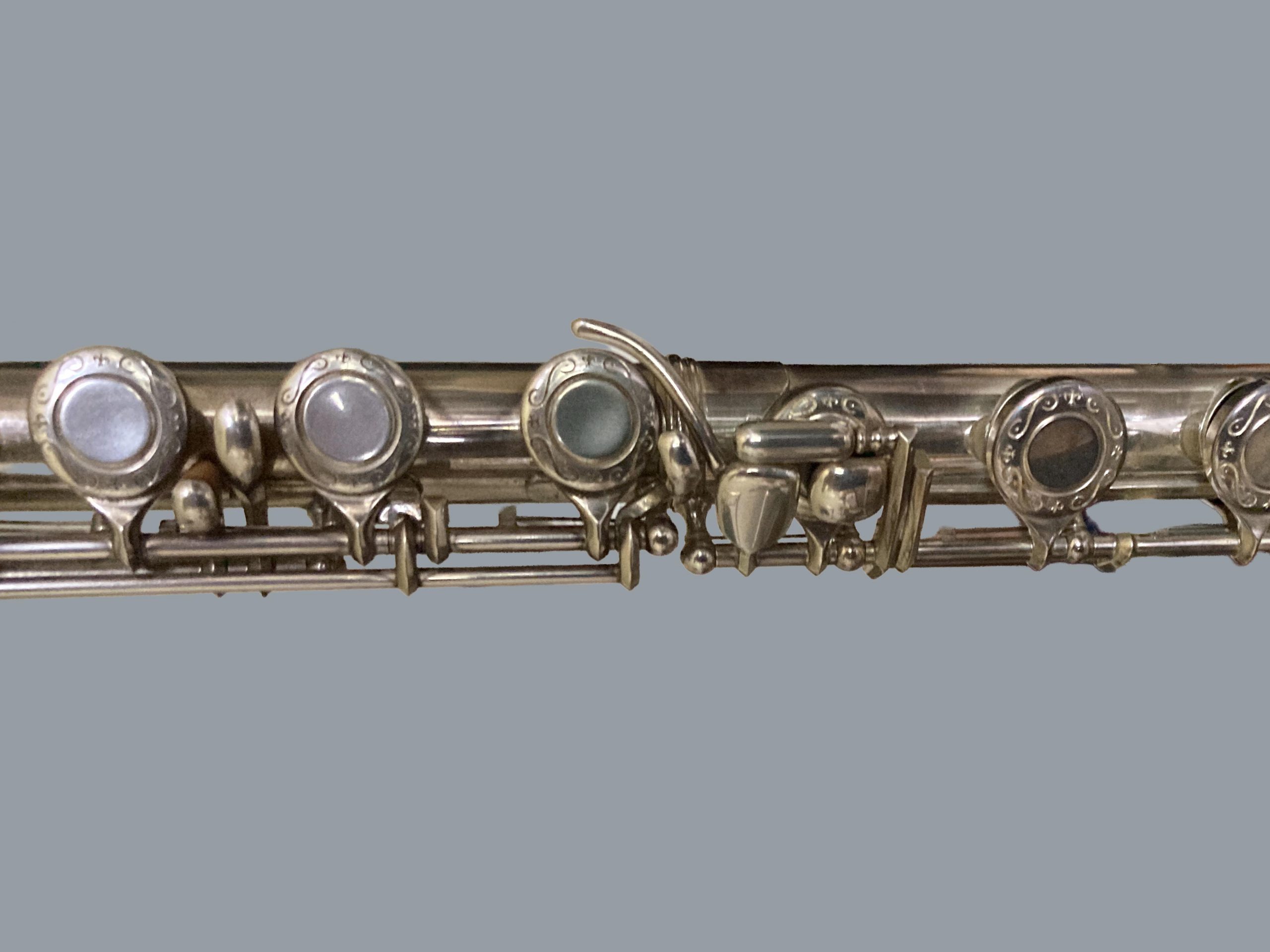
1998 Tom Green flute with unraised D# key and D crescent, stacked Murray trills.
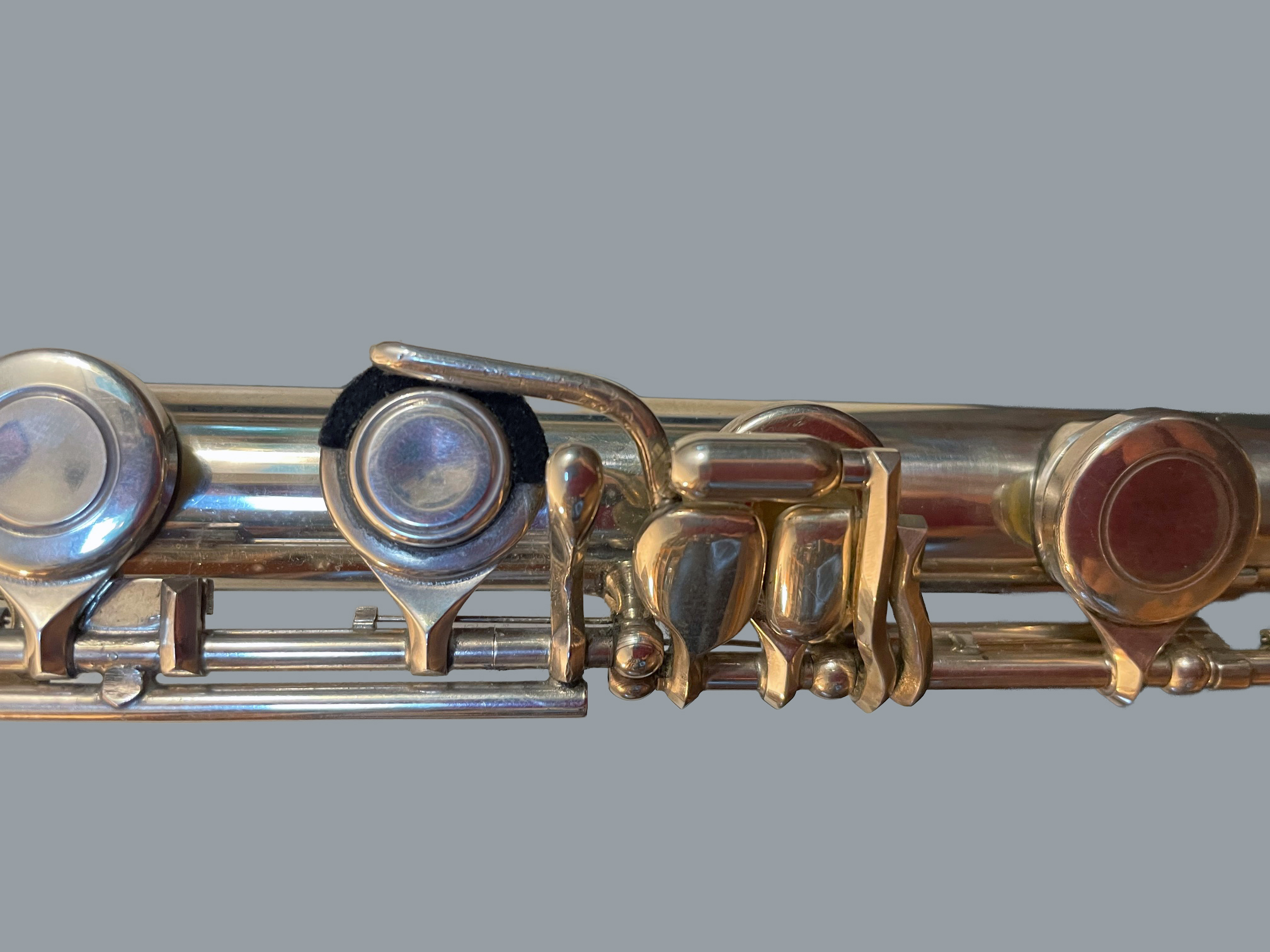
2004 Murray-Moore-Lasewski Finale with unibody, raised D#, overlapping D crescent and stacked Murray trills (not shown).
Tom Green recalls: “I remember when I went to Jack’s shop and we both looked in amazement at the dimensions of the Lasewski scale… We could not believe it would play. Comparing the placement of the tone holes, it was quite different from regular flute scales. Alex said it was to be matched with the head taper.
I know that I went ahead and made the mandrels and I must have made the bodies for Jack. I am assuming that Jack did not make the tooling. The head mandrel was made at a machine shop my brother and I owned. It was made on a Okuma CNC machine…
Jack made many Murray flute keys by piecing parts together. I started making casting patterns to save time and for consistency.”